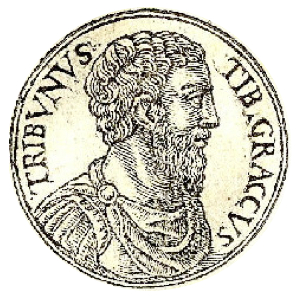
gracchusdixit

Two Thousand Years Ago, the Brothers Tiberius and Gaius Gracchus Sacrificed a Life of Privilege to Defend the Interests of the Roman People. They Were Murdered for Their Efforts.

A Dangerous Idea

Tiberius GracchusThe French philosopher and journalist, Emile Chartier, once observed: “Nothing is more dangerous than an idea when it is the only one you have.”  For two hundred years, we have been in the thrall of one, overpowering idea that is not only dangerous but fraudulent.  That idea is the notion that the “neoliberal” economic system, a.k.a., global capitalism, is the only way the world can work, as if our current economic arrangements were like the laws of physics or biology—inexorable and utterly beyond our control.

We have Adam Smith, the spiritual father of capitalism, to thank for this.  It was Smith who first conjured up the fairy tale of the “invisible hand,” with its implication that “the market” is somehow part of the divinely ordained fabric of the universe.

Thanks to Smith, the proponents of neoliberalism never tire of telling us that the central characteristics of global capitalism—lower wages, cut-throat competition for jobs, the relentless pursuit of profit—are simply the way the world works and will always work.

Neoliberal philosophers go further, claiming that prosperity and personal freedom are inseparable from the “free market” and “free trade,” that we cannot have the one without accepting the other.  Never mind that you won’t find one word about the “free market” or “free trade” in the Declaration of Independence, the Constitution of the United States, or the Bill of Rights.

Neoliberal historians would like us to believe that global capitalism is single-handedly responsible for the innumerable scientific, technological, and medical advances of the last two hundred years, that without capitalism we would still be living in the Dark Ages, that all progress depends on accepting and expanding  the economic system they revere.  Never mind the fact that capitalism had nothing whatever to do with the discoveries of Galileo or Copernicus, Marie Curie or Albert Einstein, William Harvey or Jonas Salk.

Neoliberal politicians assert that property rights are indistinguishable from human rights, that every encroachment on the one—in the form of redistributive taxes, social welfare, organized labor, or public regulation of business—is a violation of the other.  Never mind the obvious moral distinction between property and people, between a bank account and a human being.

Neoliberal “reformers” lecture us that our public schools are bankrupt, that they are failing to prepare our children for the “jobs of the future,” as if the only purpose of education were to train diligent, productive, and compliant workers.  Never mind outmoded ideas like intellectual growth, informed citizenship, or the sheer love of learning,

Neoliberal institutions like the International Monetary Fund and the World Bank never tire of demanding that entire nations must, if they want to survive, tow the line, slash public spending, “liberalize” their labor markets, privatize public services, and pay their creditors at all costs.  Never mind quaint ideas like democracy or national sovereignty, which must bow before the market, and if they won’t bow, must be forced to their knees.

The neoliberal narrative has been so pervasive for so long that it has rarely been questioned, even by its victims.  We have, nearly all of us, acceded to the fraudulent ideology that profit, growth, consumption and competitiveness are the sole metrics of human progress.

But that is beginning to change.

Four months ago, the Greeks elected an unapologetically socialist government, which is struggling against fierce odds to roll back the crippling austerity imposed upon that country by the neoliberal financial institutions of Europe.  Those institutions may yet strangle the Greeks into submission, but if they do, the price may be the unraveling of the European Union.

Less than a month ago, the Scots voted overwhelmingly for the Scottish National Party, utterly rejecting the neoliberal catechism of a conservative government in London.  If that government does not change its ways, the consequence will certainly be the diminution, and could even mean the dissolution, of the United Kingdom.

Just days ago, Democrats in Congress delivered a stunning setback to their own President’s attempt to push through yet another of the many so-called “free trade” agreements that have accomplished little in the last thirty years except to enrich corporations, despoil the environment, and destroy millions of American jobs.  This latest agreement may yet go through, but if it does, a Democratic President will have betrayed his own party by conspiring with the Republicans, with results that no one can foresee.

All around the world, people are beginning to recognize the neoliberal fairy tale for what it is: a fiction  that doesn’t even remotely resemble reality, a myth that conveniently benefits those at the top.  Property rights do not give anyone the right to treat other human beings as if they were nothing but assets and chattel.  It wasn’t the “free market” that improved the human condition; it was the freedom to think.  Global capitalism isn’t part of the natural order; it is a manmade creation, which mankind can freely change.

It was the astronomer, Carl Sagan, who said:  “Once you give a charlatan power over you, you almost never get it back.”  We’ve been giving the neoliberal charlatans power over us for too long.  There is still a chance, a slim chance, that we can get it back.

Can He Do It?

Tiberius GracchusHillary Clinton, the all-but-inevitable Democratic Presidential nominee, finally has some competition:  Martin O’Malley of Maryland, Lincoln Chafe of Rhode Island, and Bernie Sanders of Vermont.  The three men couldn’t be more different.

O’Malley is a classic life-long politician.  While still in college, he began working on Democratic political campaigns.  After college, he went to law school, where he continued to be involved in politics.  After law school, he spent merely two years as an Assistant State’s Attorney, then promptly ran for the Maryland Senate.  Having lost that race, he no less promptly, but far more successfully, ran for a seat on the Baltimore City Council.  Using that as a springboard to become Mayor of Baltimore, he ultimately went on to serve two terms as Governor of Maryland, winning both terms by huge margins.

There is nothing wrong with any of this.  Far from it.  But the trajectory of O’Malley’s career is so predictable that it’s almost funny.  It marks him as one of those conventionally ambitious politicians we are all too familiar with.

To combat this stereotype, O’Malley is trying to distinguish himself as a progressive warrior all the while painting Hillary Clinton as a pawn of big Wall Street donors.  There may be more than a dollop of truth in that.  Nonetheless, his progressive, anti-Clinton rhetoric is a day late and a dollar short, since Hillary is already singing her own progressive song and doing a pretty good job of it.  What’s more, O’Malley’s record as Mayor of Baltimore and Governor of Maryland is mixed.   It was O’Malley who introduced many of the policing tactics that some believe culminated in Baltimore’s recent race riots, and it is doubtful that the Democratic Party will easily bring itself to nominate a candidate who is viewed suspiciously by minority voters.

Lincoln Chaffe is a less predictable and, one might almost say, quixotic candidate.  He may well be the last member of that all-but-extinct species: the public-spirited New England Brahmin.  The first Chaffe arrived in Massachusetts almost 400 years ago, and his family tree includes two governors, two U. S. Senators, and two generals, as well as a distinguished Harvard philosopher and civil libertarian.  He attended Phillips Andover, an elite boarding school where Jeb Bush was a classmate, then went on to Brown, where he majored (if you can believe it) in classics.  After Brown, Chaffe did not set out to become a politician like his forebears.  He moved to Montana, where—I’m being serious—he learned how to shoe horses, spending several years working on race tracks.

When Chaffe finally returned to Rhode Island to enter politics, he returned as an old-school Republican: conservative in fiscal matters, liberal—in fact, very liberal—on social issues.  As it became clear that the Republican Party was being hijacked by the hard right, Chaffe left the party to become an Independent and, ultimately, a Democrat.

All this, you might think, would make Lincoln Chaffe at the very least an interesting candidate.  But there are two problems.  One is that he is sadly inept in front of a microphone.  The other is that his obsession is foreign policy.  He was the sole Republican Senator to vote against the war in Iraq and believes that the United States should abandon its imperial pretensions in favor of a less aggressive, more consultative role in the world. This is a laudable notion but one that is unlikely to energize an electorate that, while skeptical of our costly adventures in Middle East, remains scared to death of terrorism.

In the end, for very different reasons, both O’Malley and Chaffe seem unlikely prospects to win the Democratic nomination.

The prospects of the Junior Senator from Vermont are a different matter—though you would never know it by listening to the pundits in the media.  Although he has caucused with the Democrats during his entire time in the Senate, Bernie Sanders isn’t a member of their party.  He is an Independent, who describes himself without hesitation or apology as a “democratic socialist” along European lines.   Indeed, he is an out-and-out admirer of Scandinavia’s social democracies, with their steep, redistributive tax rates and broad social safety nets. Because of all this, it is widely assumed among the chattering classes on both right and left that Bernie Sanders has no chance of winning the Democratic nomination, let alone the Presidency.  One of the chatterers recently dismissed his prospects with the words: “He’s a socialist, for God’s sake.”

That may be.  But what the pundits routinely overlook is the fact that Bernie Sanders is far from being a utopian dreamer.  On the contrary, he is a formidable, determined, and remarkably effective politician.  Having served four terms as the most popular mayor in the history of Vermont’s largest city, he spent 16 years as his state’s sole representative in the House of Representatives, where he simultaneously stuck to his principles and managed to get a great deal of practical work done.  When it came time for “Bernie”—which is how Vermonters speak of him—to run for the Senate, he was elected by a landslide.  And when he declared his intention to seek the Democratic nomination, he raised millions of dollars in small-donor contributions in a matter of days—a feat that surprised just about everyone except the candidate himself.

The reason is that millions of Americans recognize in “Bernie” that rarest of creatures: an honest politician who means what he says and says what he believes.   He has never attacked an opponent personally and has never run a “negative” ad.  Instead, he insists on sticking to the issues.  He is a fearless enemy of Wall Street and advocates breaking up the big banks.  He is a tireless champion of the middle class and is calling for substantially higher taxes on the rich.  He believes that our social and economic system is rigged and argues fiercely for union rights, universal child care, free college education, and the expansion—rather than the dismantling—of Social Security and Medicare.  If all that amounts to “socialism,” then we are on the verge of becoming a socialist country, for an overwhelming majority of Americans want precisely the same things.

Most important than all of that, Bernie Sanders isn’t running to gratify his ego, and he didn’t decide to run until he was sure that he had a fighting chance.  His odds of winning the Democratic nomination may indeed be slim; but they aren’t zero, either.  Those who underestimate “Bernie” do so at their peril.  He has surprised the pontificators before.  He may yet surprise them again.