Il Duce È Vivo
by Gracchus
 The history books tell us that Benito Mussolini, the founder of fascism and for more than 20 years the dictator, or Duce, of Italy, was executed on April 28, 1945 by communist partisans, as he and his mistress were attempting to flee to Switzerland after he had been deposed by his own fascist party. His corpse was hauled off to Milan, where it was spat upon, defiled, and ultimately hung from a meathook, upside down, like a gutted carcass in an abattoir—an ignoble end for the man who had once imagined himself to be a latter-day Roman Caesar.
It now appears, however, that the history books may have gotten it wrong—for Benito Mussolini, or his dead ringer, seems to be very much alive and well, and may soon win the Republican nomination for President of the United States. The name of the Duce’s American avatar is Donald J. Trump.
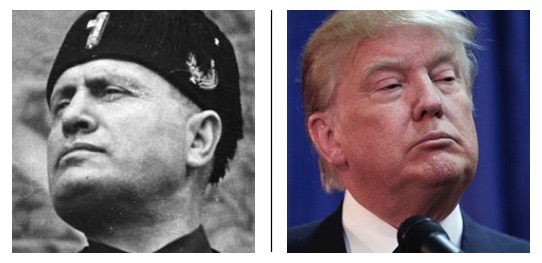 Apart from the rather creepy physical likeness between the Duce and “the Donald,” their temperamental and political similarities are both innumerable and in some cases frightening:
Before they turned to the political right, both men spent years on the left. Mussolini was for decades an ardent socialist, just as Trump was a Democrat, hobnobbing with the likes of Bill and Hillary Clinton. Mussolini’s socialist parents named him Benito, after Benito Juarez, the “Abraham Lincoln of Mexico” and the leader of a populist insurrection against one of the many right-wing regimes that have oppressed that country. Trump got the name “Donald” from his mother, whose family hailed from Scotland, which was then, as it is now, the heartland of British left-wing politics.
The public persona Mussolini presented to the world was that of a bold, pugnacious, and, above all, strong leader, who could get things done. Trump’s strong suit, by his own account, is “management,” which is little more than a warmed-up version of the old claim that “Mussolini made the trains run on time”. Some people are still prepared to believe, as they did in Mussolini’s day, that a penny’s worth of efficiency somehow justifies a plenitude of evil. Adolf Hitler, the Duce’s far more demonic imitator, deployed the same trick. All the while he was exterminating Jews, Slavs, and Gypsies, he was supplying the German people with Volkswagens and autobahns. There are some in the Trump camp today who might consider that to have been a fair bargain.
Both Trump and Mussolini can fairly be described as “theatrical”. Of course, all politicians, who play out their lives on the public stage, must, at least to some degree, be performers. But the performance antics of Trump, like those of Mussolini, are positively operatic: larger than life, over the top, alternatively bathetic and pathetic. Trump seems to crave the limelight like a drug addict groping for a fix, and he manipulates his suppliers in the media with brilliant cunning, as did the Duce, who made a living as a political journalist long before he became Italy’s political leader.
Both men also qualify as unrepentant bullies. Their first and predominating impulse is to intimidate their critics with inflammatory rhetoric or, when that fails, physical violence. Just as Mussolini surrounded himself with black-shirted thugs in jack boots, Trump surrounds himself with bodyguards in expensive suits, who are paid to pummel anyone who dares to interrupt or question the tirades of their boss. Trump routinely laughs this off, as Mussolini once did. To fascists and Nazis, beating up opponents, burning books, imprisoning or exterminating those who do not agree, is harmless “fun”.
Trump, like Mussolini, revels in phony patriotism, the rhetoric of nationalism, and the glorification of war, despite the fact that he has never served in any war or paid its price, any more than his draft-dodging predecessor, the Duce, did. Trump would have us “bomb the hell” out of anyone he imagines to be a threat, torture anyone he suspects of being disloyal, and “rough up” anyone who is impolite enough to ask questions. Mussolini, who once said, “Three cheers for war,” would probably have approved.
Mussolini invented the idea of fascism largely to glorify himself—an ideology that Hitler later “improved upon” with horrific consequences—much as Trump launched his Presidential campaign to burnish his egocentric “brand”. In neither case do coherent political ideas or policy prescriptions play much of a role. Unlike socialism, communism, libertarianism, liberalism, or democracy—all of which have consistent intellectual underpinnings, whether you agree with them or not—fascism is a conveniently loose ideology. It is less an ideology than a cult—a cult of personality—ideally suited for narcissist egomaniacs like “the Donald” and the Duce.
Because of all of this, many people, including Republicans, have begun to ask out loud whether Donald Trump a fascist. It’s about time the question was asked, but the only honest answer is: No one knows. No one knows, because no one knows whether Donald Trump believes in anything at all—apart from his own self-glorification.
What we do know, however, is that all too many of those who support Donald Trump are fascists in fact, if not in their own minds.
Anyone who is prepared to exchange freedom for “security” is a fascist. Anyone who believes that the United States of America belongs uniquely to the members of one class, race, or religion is a fascist. Anyone who laughs and stomps his feet in raucous approval as political protestors are pummeled is a fascist. Anyone who is willing to sacrifice democracy and personal liberty on the altar of “strong leadership” is a fascist.
Benito Mussolini once said to an American journalist: “Democracy is beautiful in theory; in practice, it is a fallacy. You in America will see that some day.” If we do not come to our senses soon, if we do not reject a politics of rage over reason, if we continue to justify hating and demonizing our fellow Americans, the Duce’s awful prediction may yet come true. By then, it will be too late, and the guilt will be ours.
 gracchusdixit