gracchusdixit

Two Thousand Years Ago, the Brothers Tiberius and Gaius Gracchus Sacrificed a Life of Privilege to Defend the Interests of the Roman People. They Were Murdered for Their Efforts.

Category: Uncategorized

Bad Arguments from a Good Lawyer

Tiberius GracchusThere are many reasons to vote for Hillary Clinton, not the least of which is that she would, even on the worst of days, be infinitely preferable to any of the odious candidates running for the Republican Presidential nomination.  That said, the case Clinton is trying to make for herself—and against her opponent Bernie Sanders—is flimsy at best and ultimately damaging to her prospects of becoming the Democratic nominee.

That case rests on three arguments:

(1) That she is the more experienced of the two candidates and therefore more qualified to be President.

(2) That she is more electable than Bernie Sanders, in part because “Americans will never vote for a socialist”.

(3) That she is more pragmatic, can “reach across the aisle,” and will therefore be able to get things done, the implication being that Sanders is an airy-minded and stubborn ideologue who will accomplish nothing.

The problem is that none of these arguments holds up under even the slightest scrutiny.  Indeed, they are mere assertions, scarcely qualifying as arguments at all.

First of all, and as a simple matter of fact, Hillary Clinton does not have “more experience” than Bernie Sanders.  The opposite is true.  She spent two terms in the United States Senate and four years as Secretary of State, for a total of 16 years in public office.  She has run for election office three times, not counting this election, and won twice.  Sanders spent four terms as a mayor, eight as a Congressmen, and two as a Senator, for a total of 37 years in public office.  He has competed in 15 elections, winning 14.  Although Hillary Clinton is a supremely intelligent and accomplished person with innumerable assets, “more experience” in public life isn’t one of them.

She does, to be sure, have more experience in foreign affairs by dint of her time as Secretary of State.  Some believe that she was a success in that role, while others claim that she was a failure.  The only fair verdict is that her record is mixed.  On the other side of the ledger, her legislative experience and accomplishments are indisputably more limited than those of Sanders.  More about which in a moment.

The second argument—that Clinton is more electable—is groundless.  In virtually every poll, matched against virtually every conceivable Republican candidate, Clinton barely wins or loses outright.  Sanders, on the other hand, trounces nearly every potential Republican opponent.  What’s more, his approval ratings are far better than hers, which aren’t very good at all and, given her many years in the public eye, aren’t likely to improve.

Polls, of course, are not elections.  It is possible—indeed probable—that voter intentions will change before the election takes place and will change more than once.  There is no reason, however, to presume that attitudes toward Clinton will strengthen whereas those toward Sanders will inevitably weaken.  Whatever may happen in the future, the polls are the only evidence we have at present.  Based on that evidence, it is absurd to claim that Hillary Clinton is more electable than the Senator from Vermont.

As to assertion that “Americans will never vote for a socialist,” the only reasonable response is:  who knows?  The last time Americans actually had a chance to vote for a socialist was 1920.  A scant three years after the Russian Revolution, that socialist got three percent of the vote.  Today, almost a century later, 47 percent of Americans say they would be prepared to vote for another socialist—which is about the same number of people who say they are prepared to vote for Hillary Clinton.

Finally, there is Clinton’s attempt to draw a line in the sand between her own “pragmatic realism” and what she insinuates to be the “impractical idealism” of her opponent.  Clinton is not alone in making this insinuation; she has been joined by virtually every power-broker in the Democratic Party, including Barack Obama, though the President has been careful to avoid taking sides in an explicit way.

The problem, once again, is that the evidence for this assertion is non-existent.

Clinton’s first adventure in “pragmatic realism” on the national stage famously occurred in 1993, when she became her husband’s point person in an attempt to revamp and reform our dysfunctional health care system.  That attempt failed so spectacularly that the country had to wait 17 years for another Democratic President to give it a go.

In Congress, Hillary Clinton was a Democratic Senator from one of the largest states in the country.  She served on four permanent committees and chaired none.   Bernie Sanders, an Independent from one of the smallest states in the country, serves on five committees, is the chairman of one and the ranking minority member of another.  Clinton sponsored or co-sponsored about 3,000 bills or amendments.  Sanders has sponsored or co-sponsored nearly 7,000.  Indeed, Sanders has perfected the art of attaching bi-partisan amendments to major legislation, enabling him to get dozens of progressive measures through an overwhelmingly conservative Congress, one small, pragmatic step at a time.

If the ultimate definition of “pragmatism” is results, then Hillary Clinton’s claim to be more pragmatic than Bernie Sanders falls a bit short.

All that aside, Clinton’s argument that she will be able to get more done if elected President is nothing but a red herring.  The ultimate truth is that neither Clinton nor Sanders is going to have an easy time dealing with the Congress that is elected in November.  The Democrats have a decent chance of regaining ground in the Senate but no chance at all of winning a majority in the House until the next Census in 2020 allows Congressional boundaries to be redrawn.  Either candidate will therefore face a hostile House of Representatives.

Republicans will oppose the policy proposals of a President Sanders—that is certain.  But they will loathe the very idea of a President Clinton.  Having seen them do everything in their power to humiliate and eviscerate Barack Obama, why do we imagine they will do anything less to Hillary Clinton?  Indeed, members of the tea party have already declared war on her, threatening to begin impeachment proceedings the moment she takes the oath of office.

Hillary Rodham Clinton is a lawyer by training and by all accounts a very good one.  If she wants to defeat Bernie Sanders and win the nomination, she’s going to have to come up with a more convincing case.

Let Them Drink Lead

Tiberius GracchusOn the eve of the French Revolution, as the people of France grappled with social unrest, economic collapse, and widespread famine, their Austrian-born Queen, Marie Antoinette, infamously quipped:  “Let them eat cake.”  Except that she didn’t.  We shall never know who actually uttered those words, if anyone ever did.   What we do know is that Marie, whatever her failings, was not the heartless, remote, and empty-headed puppet she has been made out to be.  On the contrary, she seems to have been an intelligent person, who empathized with her people, understood their plight, and, if she had had the political power that her era denied to all but a handful of women, probably would have done something about it.

The same cannot be said for the Republicans who run the state of Michigan, whose indifference to the plight of their poorest citizens makes the ancien régime of pre-revolutionary France seem positively benign.

Five years ago, Michigan’s legislature passed a law empowering its governor, Rick Snyder, to appoint “emergency managers” for towns or cities in financial trouble, suspending democratic government for as long as he decreed to be necessary.  This was not the first such law in Michigan, but it was, by far, the most sweeping.  If the citizens in those municipalities chose to object, they were given a mere seven days to file an appeal—and then, not to a disinterested third party, but to the very governor who appointed the emergency managers in the first place.

The purpose of this law, let it be said, was not to revitalize these troubled communities by investing in infrastructure, creating jobs, or improving the local economy.  The purpose was—and is—to cut costs, balance the books, and, above all else, pay off creditors.  Along the way, contracts with public service unions can be revoked, pensions can be denied, public services can be eliminated or privatized, and community assets can be sold.  Perhaps the most infamous example of the last occurred in Detroit a couple of years ago, when Snyder’s emergency manager came very close to auctioning off the masterworks of the Detroit Institute of Arts, one of the most splendid museums in the world.  Fortunately, national outrage was so great that even Governor Snyder’s absolute financial monarch had to back down.

Since the emergency manager law was passed, almost a dozen Michigan towns or cities—in every case but one, with overwhelmingly African-American populations—have been turned over to the tender mercies of Snyder’s proconsuls.  Their performance to date has been abysmal, even by their own criteria.  When emergency management began in the aforementioned city of Detroit, the pubic schools were running a surplus of more than $100 million.  Three years later, they were $35 million in the red.  Detroit is not alone.  Few of the municipalities subjected to the ministrations of Snyder’s dictators have emerged in sound, or even remotely better, financial shape.   The emergency management system has been a disaster.

By far the worst of its disastrous consequences has been the poisoning of the public water supply of Flint, about an hour’s drive north of Detroit.

By almost every measure, Flint is a sad and depressing place.  But it wasn’t always so.  Well into the 1970s, Flint exemplified the American Dream.  It was in Flint that the UAW waged and won a history-making strike against General Motors, transforming the lives of Flint’s auto workers as well as millions of other working Americans.  The tide turned, however, when Ronald Reagan became President.  GM, despite record profits, laid off thousands of workers in Flint and moved most of its production to Mexico.  A generation later, after a relentless drumbeat of union-bashing, trickle-down economics, and redistributive taxes favoring corporations and their investors, Flint went bust and is now one of the poorest cities in the country.

About two years ago, one of Michigan’s emergency managers took charge.  His mission was to pay off Flint’s creditors by cutting costs.  One of the cost-cutting measures was to switch the source of the city’s water supply from Lake Huron sixty miles away to the Flint River.  Being closer to home, river water was cheaper.  It was also filthy, with a totally different chemistry from that of one of the largest glacial lakes in the world.

The corrosive muck of the Flint River quickly degraded the city’s decrepit pipes and cisterns, releasing a variety of dangerous contaminants.  The worst was lead, which is toxic and particularly damaging to the nervous system.  In a matter of months, the entire population, including 8,000 children, had been exposed.  The worst exposure occurred in the poorest part of the city, which is farthest from the river, giving the stagnant water in the pipes more time to do its dirty work.

When the nervous systems of young children are exposed to lead, one of the inevitable consequences is mental impairment.  Their ability to learn will be stunted; their cognitive faculties will be diminished; their opportunities in a world that relies increasingly on knowledge and the ability to process information will be limited permanently.  The damage can be mitigated, with enough medical help and educational investment, but it cannot be reversed.  There is no remedy that will ever cure it entirely.

The first signs of lead poisoning in Flint emerged quickly, yet they were ignored—and even worse, denied—not only by the city’s emergency manager but also by Michigan’s Department of Environmental Quality, both of whom reported directly to the governor.   It was only when the evidence became overwhelming, leading to an avalanche of criticism, that Governor Snyder began to respond.  Even now, when it is indisputable that incompetence or indifference at the highest levels of his administration led to the poisoning of  100,000 people, the governor’s response has been to make excuses, point fingers, and drag his feet.  It would appear that paying off creditors is the only emergency he can bring himself to manage.

Poor Marie Antoinette, who never actually said “let them eat cake” to the French people, was hauled through the streets of Paris in an open tumbrel, her hands tied behind her back and jeered at by the crowd, until she reached what is today called the Place de la Concorde, where she ascended the steps of a scaffold and lost her head.  It is doubtful that the governor  and legislators of Michigan, who said “let them drink lead” to the people of Flint, will lose their heads, their jobs, or even a night’s sleep.  Where is Madame la Guillotine when we need her?

A Bargain Broken

Tiberius GracchusWinston Churchill famously quipped:  “The best argument against democracy is a five-minute conversation with the average voter.”  However cynical that may sound, Sir Winston was a lifelong parliamentarian dedicated to the proposition that democracy, no matter how imperfect, was infinitely preferable to the alternatives.    As he later, no less famously, put it:  “It has been said that democracy is the worst form of Government except all those other forms that have been tried from time to time.”

The survival of this “worst form of government except all those other forms” depends upon a fragile bargain between a democratic people and the leaders they elect as their representatives.  It is a bargain, the fragility and importance of which was understood not only by Churchill but, long before his time, by our Founding Fathers.

On our side of the bargain, We the People are obliged to educate ourselves about the government that represents us, the issues that confront us, and the world in which we live.  If we truly wish to govern ourselves, we cannot surrender fundamental decisions to any oligarchy or managerial class.  No matter what the NRA may say, the ultimate guarantor of our liberty isn’t guns—it is knowledge.  In the words of James Madison:

A popular government without popular information, or the meaning of acquiring it, is but a Prologue to a Farce or a Tragedy; or perhaps both.  Knowledge will forever govern ignorance.  And a people who mean to be their own Governors must arm themselves with the Power that knowledge gives.

Nor can We the People subordinate the general good to our own selfish interests by dividing our society into self-serving categories, into “us versus them”.   Democracy works for no one unless it works for everyone.   Here is John Adams:

Government is instituted for the common good; for the protection, safety, and happiness of the people; and not for the profit, honor, or private interest of any one man, family, or class of men.

The Founders believed that We the People could and should be the ultimate decision-makers in our democracy and would make the right decisions—if we were armed with “the Power that knowledge gives”.

At the same time, they understood the practical reality that ordinary citizens cannot acquire such knowledge all by themselves and, without it, may succumb to self-destructive emotions or “passions”.

Thus, the Founders believed that those who represent and govern us have a fundamental obligation to present us with the facts and tell the truth, to reason rather than inflame, to inform rather than manipulate.  To quote Madison again:

As the cool and deliberate sense of the community ought, in all governments, and actually will, in all free governments, ultimately prevail over the views of its rulers: so there are particular moments in public affairs, when the people, stimulated by some irregular passion, or some illicit advantage, or misled by the artful misrepresentations of interested men, may call for measures which they themselves will afterwards be the most ready to lament and condemn.

If We the People fail to uphold our end of the bargain, if we surrender reason to  “some irregular passion” or betray the common good for “some illicit advantage,” we become We the Mob.  If our elected leaders fail to uphold their end of the bargain, if they choose to mislead us with the “artful misrepresentations of interested men,” they become demagogues—or worse.

Unfortunately, we have reached such a low point in our national life that both these dismal possibilities have become reality.

When millions of so-called conservatives—few of whom have ever met a Muslim, know anything about Islam, or could even identify an Islamic country on a map—declare that Islam and Muslims pose a “threat to American values,” they have broken the bargain.  Their willful ignorance is surpassed only by their prejudice and hate.

When their leaders, or would-be leaders, declare that Muslims and Islam pose an “existential threat” to Western civilization—which has somehow managed to survive the collapse of the Roman Empire, the bubonic plague, centuries of religious persecution, the economic catastrophe of the Great Depression, and the human carnage of two World Wars—they have broken their end of the bargain.  Their inflammatory rhetoric is not only factually absurd, it is fundamentally dangerous.

When right-wing voters assert that our President is a Muslim, a communist, or a latter-day Manchurian Candidate secretly planted on our shores—lies that would be laughable if they weren’t so offensive—those voters, by dint of their odious stupidity, have broken the bargain.

When the Republican Party’s Presidential candidates and its representatives in Congress not only fail to correct such lies but refuse to confront the ignorance and spite of their own electorate, they have broken their end of the bargain.

It was James Madison who said:

The people can never willfully betray their own interests; but they may be possibly be betrayed by the representatives of the people.

We the People have been betrayed, and we should call the culprits to account.

Il Duce È Vivo

Tiberius GracchusThe history books tell us that Benito Mussolini, the founder of fascism and for more than 20 years the dictator, or Duce, of Italy, was executed on April 28, 1945 by communist partisans, as he and his mistress were attempting to flee to Switzerland after he had been deposed by his own fascist party.  His corpse was hauled off to Milan, where it was spat upon, defiled, and ultimately hung from a meathook, upside down, like a gutted carcass in an abattoir—an ignoble end for the man who  had once imagined himself to be a latter-day Roman Caesar.

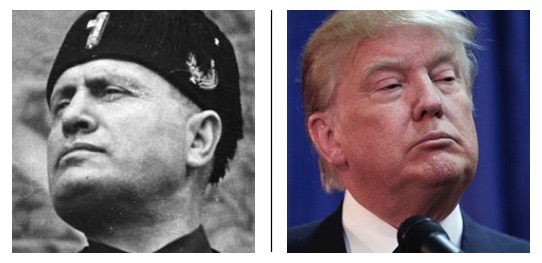
It now appears, however, that the history books may have gotten it wrong—for Benito Mussolini, or his dead ringer, seems to be very much alive and well, and may soon win the Republican nomination for President of the United States.  The name of the Duce’s American avatar is Donald J. Trump.

Trump and MussoliniApart from the rather creepy physical likeness between the Duce and “the Donald,” their temperamental and political similarities are both innumerable and in some cases frightening:

Before they turned to the  political right, both men spent years on the left.   Mussolini was for decades an ardent socialist, just as Trump was a Democrat, hobnobbing with the likes of Bill and Hillary Clinton.  Mussolini’s socialist parents named him Benito, after Benito Juarez, the “Abraham Lincoln of Mexico” and the leader of a populist insurrection against one of the many right-wing regimes that have oppressed that country.  Trump got the name “Donald” from his mother, whose family hailed from Scotland,  which was then, as it is now, the heartland of British left-wing politics.

The public persona Mussolini presented to the world was that of a bold, pugnacious, and, above all, strong leader, who could get things done.  Trump’s strong suit, by his own account, is “management,” which is little more than a warmed-up version of the old claim that “Mussolini made the trains run on time”.  Some people are still prepared to believe, as they did in Mussolini’s day, that a penny’s worth of efficiency somehow justifies a plenitude of evil.   Adolf Hitler, the Duce’s far more demonic imitator, deployed the same trick.  All the while he was exterminating Jews, Slavs, and Gypsies, he was supplying the German people with Volkswagens and autobahns. There are some in the Trump camp today who might consider that to have been a fair bargain.

Both Trump and Mussolini can fairly be described as “theatrical”.  Of course, all politicians, who play out their lives on the public stage, must, at least to some degree, be performers.  But the performance antics of Trump, like those of Mussolini, are positively operatic: larger than life, over the top, alternatively bathetic and pathetic.  Trump seems to crave the limelight like a drug addict groping for a fix, and he manipulates his suppliers in the media with brilliant cunning, as did the Duce, who made a living as a political journalist long before he became Italy’s political leader.

Both men also qualify as unrepentant bullies.  Their first and predominating impulse is to intimidate their critics with inflammatory rhetoric or, when that fails, physical violence.  Just as Mussolini surrounded himself with black-shirted thugs in jack boots, Trump surrounds himself with bodyguards in expensive suits, who are paid to pummel anyone who dares to interrupt or question the tirades of their boss.  Trump routinely laughs this off, as Mussolini once did.  To fascists and Nazis, beating up opponents, burning books, imprisoning or exterminating those who do not agree, is harmless “fun”.

Trump, like Mussolini, revels in phony patriotism, the rhetoric of nationalism, and the  glorification of war, despite the fact that he has never served in any war or paid its price, any more than his draft-dodging predecessor, the Duce, did.  Trump would have us “bomb the hell” out of anyone he imagines to be a threat, torture anyone he suspects of being disloyal, and “rough up” anyone who is impolite enough to ask questions.  Mussolini, who once said, “Three cheers for war,” would probably have approved.

Mussolini invented the idea of fascism largely to glorify himself—an ideology that Hitler later “improved upon” with horrific consequences—much as Trump launched his Presidential campaign to burnish his egocentric “brand”.   In neither case do coherent political ideas or policy prescriptions play much of a role.  Unlike socialism, communism, libertarianism, liberalism, or democracy—all of which have consistent intellectual underpinnings, whether you agree with them or not—fascism is a conveniently loose ideology.  It is less an ideology than a cult—a cult of personality—ideally suited for narcissist egomaniacs like “the Donald” and the Duce.

Because of all of this, many people, including Republicans, have begun to ask out loud whether Donald Trump a fascist.  It’s about time the question was asked, but the only honest answer is:  No one knows.  No one knows, because no one knows whether Donald Trump believes in anything at all—apart from his own self-glorification.

What we do know, however, is that all too many of those who support Donald Trump are fascists in fact, if not in their own minds.

Anyone who is prepared to exchange freedom for “security” is a fascist.  Anyone who believes that the United States of America belongs uniquely to the members of one class, race, or religion is a fascist.  Anyone who laughs and stomps his feet in raucous approval as political protestors are pummeled is a fascist.  Anyone who is willing to sacrifice democracy and personal liberty on the altar of “strong leadership” is a fascist.

Benito Mussolini once said to an American journalist:  “Democracy is beautiful in theory; in practice, it is a fallacy.  You in America will see that some day.”  If we do not come to our senses soon, if we do not reject a politics of rage over reason, if we continue to justify hating and demonizing our fellow Americans, the Duce’s awful prediction may yet come true.  By then, it will be too late, and the guilt will be ours.

Farcical, Fraudulent, Afraid

Tiberius GracchusThe big day has come and gone.  After months of almost feverish anticipation, Hillary Rodham Clinton, former Secretary of State and the leading contender for the Democratic Presidential nomination, appeared before a special committee of the House of Representatives that was convened to “get to the truth” regarding the deaths of four American diplomats in Benghazi, Libya, three years ago.   The committee was convened only after a good deal of hemming and hawing by the leaders of the Republican majority in Congress, who feared that its members, like a gang of unruly children turned loose without adult supervision, might prove embarrassing.

As it turns out, Republican leaders were right.

To date, the Benghazi Committee has cost American taxpayers $5 million (closer to $20 million, when you add up all the time and paperwork various agencies of government have had to squander to meet its incessant demands).  Having spent all that money, after more than a year of “investigating,” after interrogating dozens of witnesses, mostly in secret and behind closed doors, the Benghazi Committee has produced…exactly nothing.

This shouldn’t really surprise us—for it was never clear why the Benghazi Committee was convened in the first place.  There are a few who still defend its mission with arguments that have never been anything but pathetically unconvincing.  Even so, the committee’s few remaining defenders can no longer pretend that its mission has the slightest chance of being achieved.

Seven prior investigations took place before the Benghazi Committee was convened.  All produced the same findings and the same basic recommendations—to wit, security in Libya could have been better and should be improved wherever American diplomatic personnel work in this increasingly perilous world.  Despite the fact that Republicans in Congress  have consistently refused to give the State Department sufficient funds to protect our embassies and consulates, Hillary Clinton accepted personal responsibility for the shortcomings in Benghazi and initiated improved security measures, the implementation of which has continued under her successor, John Kerry.  In a different, more civilized age, that should—and would—have been the end of it.

But we do not live in such an age.

No amount of civilized, rational or even factual discourse has been enough to satisfy the right-wing zealots in the Republican Party.  Against all evidence, violating every standard of common courtesy or professional respect, they grilled Hillary Clinton last week like a pack of rabid dogs slavering in some dark alley, searching for a scrap of meat.  They all but accused her of criminal negligence and a deliberate “conspiracy” to sacrifice the lives of four American diplomatics for the sake of her own political career.

One claimed that State Department “talking points” which surfaced in the immediate aftermath of the Benghazi attack, were duplicitous or politically motivated, or both.    Another charged that Hillary Clinton not only failed to send military help to the diplomats in Benghazi but, worse yet, actively vetoed plans to rescue them.  Still another claimed that, on the day of the attack, Secretary Clinton went home, caring not a fig for the fate of the four diplomats and leaving her staff at the State Department to pick up the dirty details of their demise.  The most bizarre and irresponsible asserted that Hillary Clinton (or President Obama himself) had instigated a plot to sneak weapons from Libya into Syria, via Turkey or Israel, to arm Islamic terrorists.

None of these farcical and fraudulent fabrications bears even the slightest resemblance to reality, and a lesser person than Hillary Clinton would have met them with the dismissive contempt or outrage they deserve.  Instead, she responded to those who slandered her in a fashion that must to them have been infuriating—with equanimity, reason, and poise.  That is why they are so afraid of her.

Bushed

Tiberius GracchusJust a few months ago, it was all but assumed that Jeb Bush was the odds-on favorite to become the next Republican Presidential nominee.  He was the clear front-runner in a comedically crowded field, and all the stars were lined up in his favor.  He had been a popular and passably successful governor of Florida.  He was judged to be a more skillful and articulate politician than his ham-fisted and frequently incoherent brother George.  And he possessed all the advantages of the Bush name and connections, thanks to which he was the darling of the Republican establishment, able to raise money faster than King Midas once turned dross into gold.

For all these reasons, Jeb Bush seemed unstoppable.

Then, the tables turned.  Donald Trump swept into the race like a sudden thunderstorm and began, as the saying goes, to suck up all the oxygen in the room.  Before long, he had shoved other contenders, Bush most of all, into a rhetorical corner from which they were unable to escape.  Having topped the national polls for months, Jeb Bush’s standing fell like the proverbial stone.

Thus it was that last night’s Republican debate was thought by many to be Bush’s last chance to salvage a floundering campaign.  If that was the case, then the Bush ship has piled up on the rocks.  Not only did the candidate fail to rise to the opportunity the debate provided, he squandered it.

It is tempting—and not entirely inaccurate—to attribute Jeb Bush’s problems to the devastation wreaked by the Trump whirlwind and the more general tumult among the so-called Republican “base,” which seems ready to embrace almost anyone—including quiet lunatics like Ben Carson or loud-mouthed corporate criminals like Carly Fiorina—rather than established politicians.

Bush’s problems, however, go further.  They extend to the man himself.

To the surprise of nearly everyone, Jeb Bush has turned out to be a simply terrible candidate: uncertain and awkward on the stump, given to making gaffes, unable to communicate a consistent or convincing political philosophy.  Why this has turned out to be the case is anyone’s guess.  But at least three possibilities come to mind.

One is that Jeb Bush is a child of privilege, whose path to prominence was paved by others.  As a member of one of our country’s oldest families and most enduring political dynasties, he attended elite schools, sailed into politics on the strength of his name, and thereafter earned a living—if you can call it that—by sitting on a dozen corporate boards and collecting the fees. Such people are used to getting their way.  It isn’t entirely surprising, therefore, that he handles adversity badly, answers questions with prickly irritation, and greets criticism with a peevish scowl.  Matched up with a bar-room brawler like Donald Trump, Jeb Bush the  prep-school kid seems to punch below his weight.

Another possibility is that Bush is actually ill-prepared for the task that he has set himself.  Some have observed that he’s been out of politics for a decade, suggesting that he may simply be “out of practice”.  Few, however, have noted the more consequential fact that Jeb Bush didn’t have that much practice to begin with.  He came to politics late in life, and, apart from his stint as governor of Florida, has held no other elective office.  Next to his father, who served two terms in the House of Representatives, headed up the CIA, was picked by Ronald Reagan to be Vice President, and then succeeded Reagan as President, son Jeb looks like a rank amateur.

A third, more consequential, possibility is that Jeb Bush is not the “moderate” conservative he is imagined to be, which leaves him without a distinguishing purpose or a political identity.

If Jeb Bush were truly “moderate,” he should by now have been able to articulate a coherent response to Donald Trump’s immigrant-bashing nativism, Ben Carson’s evangelical lunacy, and Ted Cruz’s tea party demagoguery.  That he has been unable to do so exposes him for what he actually is: no less crazy than the crazies he opposes.

If you require any further proof of this, merely look at Jeb’s plan to replace the Affordable Care Act, a.k.a., “Obamacare.”  Its purported aim is to reduce the outrageous cost of health care.  It would do so, however, not by reducing costs but by reducing benefits, particularly for the poor, the old, and the ill.  Bush’s idea of health care reform is Dickensian: health care for the wealthy and the already healthy at the expense of those who are neither.

This extremism really shouldn’t surprise us.  It was Governor Jeb Bush, let us not forget, who decided to defy the courts of both Florida and the United States by sending state marshals to prevent Terry Schiavo from being allowed to die after ten years in a  vegetative coma—all in the name of the “sanctity of life”.

None of this is the portrait of a “moderate Republican”.  And if Jeb Bush isn’t a “moderate Republican,” why would anyone, Republican or Democrat, vote for him?  After last night’s debate, the answer seems to be clear:  they won’t.

Stumped by Trump

Tiberius GracchusIn scarcely more than 24 hours, we will be treated to the second episode of what has become America’s latest and best-loved situation comedy: the Republican Presidential debates.  This time, the emcee will be CNN, and the setting will be the Reagan Presidential Library in California.  No place could be more fitting, for if anyone must be laughing in his grave right now, it is Ronald Reagan—or rather, his ghost.

Although Reagan’s ghost now presides as the unofficial patron saint of the Republican Party, it is easy to forget that the man himself didn’t start that way.  Much like “the Donald,” he began as a figure of fun and ridicule, dismissed as a second-rate actor in second-rate movies, and not to be taken seriously by serious people.  When it was no longer possible to ignore his mystifying but undeniable popularity, the “serious” pundits and prognosticators were left to huff and puff in bewildered disbelief.  He couldn’t possibly win the Republican nomination; he couldn’t conceivably become President.  That was the verdict pronounced by the keepers of conventional wisdom thirty years ago.

Today’s huffers and puffers are reprising the same script, thirty years later.  They simply cannot bring themselves to believe that Donald Trump’s candidacy is anything more than a passing aberration, a temporary confusion between fiction and reality.  They insist that an “establishment” candidate will eventually emerge, swept to victory on a wave of big-money donations and political “facts on the ground,” which say that Trump can’t win a national election against a candidate of substance.

Accurate or not, the trouble with this familiar plot is that Republican primary voters don’t seem to care.  Indeed, none of the candidates they have embraced thus far even remotely fits the script.

It’s not just “the Donald”.  Right behind him is Ben Carson, a loony ex-neurosurgeon whose idea for reforming our ludicrous tax code is to replace it with Biblical tithing.  Not far behind Carson are the somewhat less loony but equally “anti-establishment” figures, Carly Fiorina and Ted Cruz.  Fiorina’s conspicuous claim to fame is that she very nearly wrecked Hewlett -Packard, which lost 75 percent of its market value during her tenure as CEO.  Cruz is a transparently self-absorbed demagogue, loathed by his own Republican colleagues no less than by everyone who isn’t to the right of Benito Mussolini.  None of this has stopped their rise.

Neither has it stopped the armchair experts from predicting the long-awaited resurrection of more “plausible” candidates, like the once presumptive front-runner Jeb Bush, or the still presumptive Latino vote-getter Marco Rubio, or that household name from Ohio, John Kasich.

Perhaps the experts will be proved right tomorrow night.  Trump may stumble.  Maybe Jeb Bush will finally get up off the mat and land a knock-out punch when they exchange their inevitable blows.  Perhaps Marco Rubio will at last show some spine and summon up the wits to say a coherent word.  And maybe, just maybe, John Kasich will once and for all explain to the rest of us why so many political pros seem to think that he would be a formidable candidate.

But somehow I doubt it.

The truth seems to be that, whether you like him or not, whether he wins or not, Donald Trump has turned conventional wisdom on its head.  To the chagrin of big-money donors who have grown accustomed to buying elections by bombarding the public with propaganda, he has surged in the polls without spending a penny on advertising.  To the dismay of political consultants and strategists whose livelihoods depend on their expensive expertise, he shows every sign of winning  the early primaries without employing any of them to run a traditional “ground game”.   To the horror of all who cling to notions of political decorum, not to mention common courtesy, he has violated every rule of both without suffering a jot.  On the contrary, every time he breaks those rules, his “fans” reward him for it.

No wonder the pundits are stumped by Trump.

To those pundits, I would only say this: apart from its extravagance, there is nothing about the Trump phenomenon that is any way new.   On the contrary, he is the very embodiment of a long and venerable American political tradition, in which promises pass for policy, sizzle supplants substance, prejudice trumps principle.

It was the quintessential American writer Mark Twain who said:  “All you need in this life is ignorance and confidence, and then success is sure.”  Mark Twain would not have been stumped by Trump.

An Exceptional Nation

Tiberius GracchusSince the murder of two young television reporters in Roanoke, Virginia, by an apparently disgruntled former employee of a local television station, our nation has been enacting, for the hundredth time, the sort of political Kabuki that invariably seems to follow all these tragedies.

In the first act of the play, everyone expresses horror at the crime, rushing to extend their “thoughts and prayers” to the families of the victims.  In the second act, we are assured that the perpetrators are “deranged” and aberrant individuals, deserving either punishment or pity, but in no way typical.  In the third act, a few dissenting voices—almost always on the left and usually with a tone of weary resignation—call for “sensible” gun control.  In the fourth act, opposing voices—nearly all on the right—huff and puff indignantly against anyone who is unseemly enough to “play politics in a time of grief”.  In the fifth and final act, the same sanctimonious voices demand that the 2nd Amendment rights of “law abiding citizens” must be protected against the totalitarian interventions of big government.  And with all that, the curtain falls, the media coverage moves on, and we forget all about it.

Until the next time.

For in the United States of America, there is always a next time, as one shocking murder or massacre follows another:  Virginia Tech, Columbine, Aurora, Newtown, and now Roanoke.

More shocking than the attention-getting massacres, however, is the mundane, never-ending, largely ignored spilling of blood.  Each and every day, nearly 300 Americans are shot or shoot themselves.  Each and every month, more Americans are shot to death than were killed on September 11, 2001 in the attack on the Twin Towers.  Each and every year, guns claim more civilian dead and wounded than all the soldiers killed and maimed during ten years of senseless fighting in Iraq.  None of this would be happening if it were not for the fact that 300 million guns have been set loose in our homes, in our schools, and on our streets.

The justifications for our national addiction to guns, the excuses for all the carnage they cause, are as sadly predictable as the carnage itself.   We’ve heard the same justifications and excuses—and the same evasions about what to do—time after time, and we began to hear them again just minutes after the murders in Roanoke.

Jeb Bush offered this preposterous justification:

The federal government shouldn’t be involved in gun laws, because the country’s very different.  You go to a rural area, where guns are part of the culture, to impose gun laws from Washington that are going to work in New York City, or work in a rural area, makes no sense.

It doesn’t seem to occur to Mr. Bush that countless countries around the world have both urban and rural areas, that wherever “guns are part of the culture,” people inevitably get killed, that you’re just as dead if you’re killed in the hills of rural Pennsylvania as on the streets of New York.

Marco Rubio uttered this depressingly familiar and utterly illogical excuse:

It’s not the guns.  It’s the crazy people committing these crimes.  What law in the world would have prevented him from killing them?

To which the only sane answer is:  any effective law, if we had such a law, if it was enforced.  If Rubio’s ridiculous rhetorical question made any sense, we wouldn’t bother to pass any laws in the first place, and he would be out of work.

Scott Walker didn’t bother with justifications or empty excuses.  He simply lied.  After intoning that “the common thread we see in many of these cases is a failure in the system to help someone with mental illness,” he went on to claim that he had “stepped up” the effort to combat mental illness in his own state of Wisconsin. In fact, he made drastic cuts in mental health services and dramatically undercut Wisconsin’s once sensible gun laws.

No other nation in the so-called civilized world is so addicted to guns, and no other country can match our record of carnage.  Faced with the latest bloody page in that record, those who want to become our next President have nothing to offer the victims of gun violence but “thoughts and prayers”.  These are the same people who never tire of telling us that we are a great and “exceptional” nation.  Perhaps we are.  But not in the way they imagine.

A Decisive Moment

Tiberius GracchusIn the messy and unpredictable world of American politics, few moments can be called decisive—when the electoral fate of a candidate, a political party, or an entire political ideology are changed irrevocably in front of our eyes.  Such a moment occurred in the run-up to the last Presidential election, when Mitt Romney chose a closed-door and supposedly secret dinner with big-money donors to deride 47 percent of the country as worthless “takers” dependent for their livelihoods on hand-outs from big government.  When that dismissive slur leaked out, Romney’s chances came to an abrupt end.

Another, more public and far more decisive moment occurred earlier this week, during a press conference held by Donald Trump in Iowa.  It came when Trump tried to ignore and then silence a reporter named Jorge Ramos, and when all that failed, ordered him to be physically escorted from the room like some sort of common criminal.

Ramos wasn’t a mischievous heckler or a disruptive activist, let alone a criminal.  He was a journalist. Many observers in the mainstream media described him as an “award-winning reporter”—which he most certainly is.  But Jorge Ramos is a good deal more than that.  He is the anchor of the flagship newscast of Univision, the country’s dominant Spanish-language television network, where he has covered the issue of immigration more thoroughly—and more thoughtfully—than anyone else on television.  In doing so, he has become the symbolic champion of every immigrant, Hispanic or otherwise, who came to the United States, hoping for opportunity and a better life.

One of the more percipient observers of the confrontation in Iowa went so far as to describe Ramos as a combination of Anderson Cooper and Walter Cronkite.  But even that comparison is an understatement.  Jorge Ramos is—by far—the most popular and influential television journalist in the country and quite possibly in the history of the television news business.  His viewership at Univision dwarfs the audiences for the national newscasts of ABC, CBS, and NBC as well as the audiences that slavishly follow Bill O’Reilly, Sean Hannity, and the other conservative cheerleaders at Fox News Channel.  It is impossible to overstate the regard in which he is held by Hispanic Americans in general and Mexican Americans in particular.  Thus, it is impossible to overstate the damage that Donald Trump has done to himself and to the party he so recently embraced.

Everything about Trump’s behavior—his tone, his words, even the contemptuous scowl on his face—was offensive, crude and insulting.  It revealed, once and for all, the dismissive racism of his opinions and of those who support those opinions so enthusiastically.  It has been said, not least by the party itself, that Republicans cannot hope to win another national election without at least thirty percent of the Hispanic vote.  The last Republican Presidential candidate to do that was George W. Bush, eleven years ago.  Any hope of Republicans doing so again evaporated Tuesday.

There are those who say that Trump has no real chance of becoming the Republican nominee, but in truth, that no longer matters.  If he is rewarded for his treatment of Jorge Ramos with favorable polling results by the party’s rabid anti-immigrant “base”—which seems altogether likely—he will brag and boast and declare himself to have been vindicated.  Even candidates who may be tempted to oppose him, like Jeb Bush, can only go so far without jeopardizing their own hopes for winning the nomination.  Trump is calling the tune, and no amount of fancy footwork by other candidates can any longer change it.

Everything Trump has done in the wake of his confrontation with Ramos—calling him a “screamer” and a “madman,” among many other epithets—has merely served to dig the hole deeper.  Before the debacle in Iowa, there was a slight chance that a moderate candidate might somehow persuade Hispanics to vote Republican.  Even that slight chance is gone.

Of course, something else might occur to change all this.  After two years of wasting several million dollars of the public’s money, the Republican committee investigating “Bhengazi” may actually come up with something.  An indifferent electorate may eventually stir itself to care just a bit about the faux scandal of Hillary Clinton’s private email server.  Or the earth may stop revolving around the sun.  In the world of politics, the unexpected can, and sometimes does, happen.

What Donald Trump has done, however, cannot be undone.  For the 50 million Americans of Hispanic heritage, the face of the Republican Party is now the face of Donald Trump. They will not soon forget how he treated the one public figure they respect more than anyone else.  They will not forget how he treated Jorge Ramos.  Nor should anyone else.

New Solutions to a Non-Problem

Tiberius GracchusNothing so fires up the so-called Republican “base” as the so-called “problem” of illegal immigration.  To listen to the most rabid of the countless fear-mongers on right, you would imagine that the country was being gobbled up by an invading horde of barbarians bent on rape, rapine, and the ruin of civilization as we know it.

Several days ago, Donald Trump poured kerosene on the flames of this hellish vision with two uniquely incendiary proposals: (1) to overturn the 14th Amendment, which declares any person born in the United States to be a citizen; (2) to deport, en masse, not only illegal immigrants but their U.S.-born children.  The latter, he added without even a wink of irony, would serve to “keep immigrant families together”.

There are, of course, one or two practical difficulties with what Trump has proposed.  He did not say, for example, exactly what it might take, not to mention cost, to identify, process, and deport 11 million people and their children, which is something that no democratic society has ever contemplated.  Nor did he explain how the Constitutional rights of American citizens could suddenly be revoked, since no legal or historical precedent for doing such a thing exists.  Indeed, the inviolable principle of birth-right citizenship goes back centuries, to English common law, well before the Constitution itself was written.

All that aside, Trump’s proposals at least have the virtue of being clear, which is more than can be said for the empty rhetoric and endless equivocating of the other Republican Presidential candidates.

What is far from clear, however, is whether illegal immigration is even a problem to begin with, let alone a problem that needs drastic solutions of the sort Trump suggests.

It is broadly claimed—and widely believed—that illegal immigration is a catastrophic financial drain on the country.  Several years ago, for example, the resolutely right-wing Heritage Foundation (which led a fight to shut down the federal government long after the Republican Party had abandoned the idea as a self-destructive waste of time) published a study asserting that the average illegal household costs the country more than $14,000 a year.  That conclusion, along with the study as a whole, has since been thoroughly debunked.  Nonetheless, the perception that illegal immigration is an economic threat of the first order lives on.

The truth of the matter is that the net cost of illegal immigration has been studied to death by innumerable sources whose bona fides are a tad more reputable than those of the Heritage Foundation.  Those sources include professional economists, academics, non-partisan think tanks, the Congressional Budget Office, the IRS, the Social Security Administration, and the revenue and tax agencies of dozens of states, both red and blue.  For every study that points to a net cost, there are far more that point to a net gain.  Indeed, every economic objection to illegal immigration collapses under inspection.

For example, some insist that illegal immigrants must cost the country money, because illegal immigrants don’t pay taxes.  As it happens, they do.  At least six million illegals file and pay income taxes every year—because the IRS cares only about collecting taxes, not about the status of those who pay them.  In addition, all illegals pay the same taxes on merchandise, gasoline, liquor and tobacco as everyone else.

Some claim that illegal immigrants “steal” jobs from American citizens or lower their wages.  There is evidence that illegal immigrants compete for jobs with some American citizens—almost entirely with those who dropped out of high school and have limited skills.  The best way to solve that problem, of course, would be to keep such people in school, fund those schools properly, and equip them with the skills they need, a subject on which anti-immigrant demagogues have little to say.  There is no evidence—repeat: no evidence—that the rest of the job market is affected in any appreciable way.

Some complain that illegal immigrants get free medical care.  It is true that illegal immigrants who show up in emergency rooms will eventually be attended to, because federal law requires that everyone who shows up in an emergency room should be attended to.  But illegals, like everyone else, will  also get a bill—unless they can prove an inability to pay., which is something that most illegals, for all the obvious reasons, are reluctant even to attempt.

Far more importantly, those who so desperately want to vilify and criminalize illegal immigrants either don’t realize or refuse to acknowledge the extent to which illegals subsidize their own prosperity.  Millions of illegals pay both Social Security and Medicare taxes, from which they never receive a penny in benefits, subsidizing those who do.  Their low-wage labor boosts corporate profits, which is why the oh-so-conservative Chamber of Commerce is oh-so-adamantly in favor of what they euphemistically call “immigration reform”.  The labor of illegals also lowers consumer prices, particularly food prices.  If Donald Trump got his way and succeeded in deporting illegal immigrants and their citizen children, Americans would soon be paying as much for fruit and vegetables as the perfidious French.  God forbid!

In the end, the animus against illegal immigrants has little to do with the actual economic cost of their presence in our country.  It has everything to do with the entrenched entitlements, privileges, and prejudices of those who are already here.

When German immigrants poured into this country in the late 18th century, the English who had gotten here first demonized them.  When Irish and Italian Catholics arrived by the millions in the 19th century, the Protestants who then ran the country called them every vile and filthy name they could think of.  When Slavs and Jews came in their wake, the lucky immigrants who had already made their way to our shores greeted the new arrivals with racial slurs, cudgels, and violence.

We are a nation of immigrants, a heritage of which we should be proud.  The saddest aspect of this heritage is that each generation of American immigrants has been so predictably prepared to begrudge the next.  Donald Trump is merely the latest in a long line of demagogues to exploit that shameful impulse.  He, and it, should be rejected by anyone who calls himself an American.