gracchusdixit

Two Thousand Years Ago, the Brothers Tiberius and Gaius Gracchus Sacrificed a Life of Privilege to Defend the Interests of the Roman People. They Were Murdered for Their Efforts.

Category: Uncategorized

There Has To Be a Way! But What If There Isn’t?
Tiberius GracchusAfter several months of social hibernation, my wife and I finally had a chance to spend a little time with friends, keeping our distance and avoiding physical contact, of course, but at least having a chance to see one another and catch up.  Sitting around our dining table, one of those friends, who works with special needs children in her local elementary school, spoke passionately about the hardships both parents and children will experience if kids can’t return to school soon.  In particular, she said, the challenged children she helps simply cannot learn “remotely”.  For them to focus, concentrate, or learn anything at all requires personal attention and instruction.  “There has to be a way to reopen the schools,” she protested in a pleading, plaintive tone of voice.  “There just has to be a way.”

All of us can sympathize with the sentiments of our friend.  Whether we have young children or not, we all want schools to reopen.  We all long for the pandemic to end.  We all crave the chance to get back to normal, lead the lives we used to lead, and put this disruptive nightmare behind us.  

But what if there isn’t a way to make any of that happen?  What if the pandemic and its consequences are here to stay?  These are questions that we are understandably reluctant to confront.  But they are questions that can’t be ignored forever.

We have been told countless times that COVID-19 will eventually run its course and disappear or that a vaccine will soon be developed to stamp it out once and for all.  In truth, none of these hopeful outcomes is in the least bit certain.  

History is rife with examples of plagues and pandemics that never “disappeared,” but, rather, came creeping back year after year, decade after decade, century after century, until it was normality itself that disappeared.  Diseases and natural calamities have the power to wear down even the most robust and resilient societies and civilizations, to crush even the most determined and deeply felt hopes.

What’s more, the prospects of discovering a pandemic-ending vaccine are not as rosy as we have been led to believe.  Our expectations, and those of the medical experts who advise us, are colored by the almost miraculous success of the polio, small pox, and measles vaccines, which have all but eliminated some of the cruelest diseases in human history.  The fact remains that such outcomes are far from being the norm and by no means guaranteed.

The influenza vaccine, for example, which millions of people take every year, provides only short-term protection and must be constantly modified, with varying degrees of success, as new strains of the virus emerge.  There is, in fact, no “cure” for the ‘flu’.  We have merely found a way of managing it.  After 40 years of trying, virologists have yet to produce any  vaccine for HIV.  Various pharmacological “cocktails” can check its progression and reduce its lethality.  But as with influenza, there is no “cure”.  And to date, no vaccines have been developed to combat any of the seven known corona viruses that came before COVID-19.  The most lethal of these, MERS, kills four out of ten of its victims.  It has been kept in check only by the most aggressive measures of quarantine and isolation.

Counting on a vaccine to save us from this virus may, in the end, turn out to be little more than wishful thinking.

There is a parallel—and more dangerous—response to the pandemic that goes well beyond wishful thinking.  That response asks us to accept the proposition that the worst consequences of covid-19 are inevitable, that we can do little about it, that the cost in human suffering and death is the price we must pay for restoring the political, economic, and social status quo ante.  Some who make this argument do so innocently, without malign intent.  Others, like Donald Trump and members of his administration, do so with cynical and callous disregard for the lives of those they are sworn to serve.  

Whatever the motives of those who make this argument, let’s be clear:  the argument itself is fundamentally immoral, because it proposes to put a price on human life.   But even if that were not the case, its underlying premises are false.

To begin with, we can do something to contain this pandemic—not perfectly or completely or without a hefty price to pay, but certainly with more success than we have thus far achieved.  Virtually every member nation of the European Union has done a far better job of containing the virus, and when it comes to those those few that haven’t, the reasons are crystal clear, as are the lessons to be learned.  If we heed those lessons, we can still stave off the worst.

More importantly, the purported trade-off between fighting the pandemic and “getting back to normal” is not only a false choice but a delusional distraction, as recent attempts by a number of Republican states to reopen have demonstrated.  Instead of returning to normal, these states have only made matters worse—in most cases, much worse.   

We may soon have to face the possibility that we will never have a “cure” for this virus, that it will dog our steps for years to come, that the “normality” we once knew is gone forever.  The economy and the workplace may never return to what they once were; jobs and paychecks may never fully recover; children may never again be taught in the classrooms of the past; our private, for-profit health care system, having been “socialized” to fight the pandemic, may have to stay “socialized” just to survive.

We may soon reach a point when insisting that “there has to be a way” will be worse than a false hope.  It will be an insurmountable obstacle, preventing us from facing up to a new and ineluctable reality, one that little resembles the lives we used to lead, one to which we must adapt if we hope to survive.  At such a point, pretending that we can simply reopen our schools, our businesses, and our economy with the expectation that everything will return to what it once was, will be nothing less than a suicide pact with the future.
What Is To Be Done?

Tiberius GracchusIf Joe Biden is sworn in as the 46th President of the United States next January—and despite all the polls currently giving him a substantial lead over Donald Trump, that’s still a very big “if”—he will need, almost immediately, to answer the question posed by Vladimir Lenin more than a century ago:  What is to be done?  More specifically, what is to be done about a triad of unprecedented calamities now confronting the nation:  a pandemic that seems to be running amok, an economic downturn of titanic proportions that may soon morph into a depression, and a toxic political and social culture that is eating the country alive.  
It is no exaggeration to say that, if Biden does become our next president, he will face the greatest national crisis since the Civil War.  To steer our battered ship of state through this storm, he will need the moral clarity of Lincoln, the political acumen of Roosevelt, and the rhetorical skill of a modern-day Cicero or Demosthenes.  Our fractured body politic will cry out for consoling and cajoling; our broken economic system will have to be repaired or replaced; and our enfeebled political institutions will demand to be reconstituted.

The first and most pressing of the calamities we face—the global pandemic of which of which we have become the epicenter—will in some ways be the easiest to tackle.  As unpalatable as the medicine may be, we know what it is, because other hard-hit nations have swallowed the pitter pill and brought the virus to heel.   The question, therefore, is less what to do than whether we have the political will to do it.

The economic crisis is more daunting.   With at least 30 million Americans out of work, millions without health insurance, thousands of businesses shutting their doors, and entire industries facing bankruptcy or liquidation, the country hasn’t experienced an economic collapse of this magnitude since the Great Depression.  The conventional wisdom is that this represents a self-imposed, short-term disruption to an otherwise healthy economy.   That is a fantasy.  As the “V-shaped recovery” touted by Trump’s witless economic advisers recedes into the mist of magical thinking from which it came, it has become abundantly clear that our economy was in deep trouble long before the pandemic pushed it over the cliff. 

Inequalities of wealth and income had already reached grotesque levels not seen for a century.  An inefficient and unconscionably expensive medical system was already producing some of the worst health outcomes in the world.  And a self-destructive culture of private profit and debt-dependent personal consumption was already poisoning the planet and starving essential public services to death.  To cure these maladies, wrenching and fundamental changes will be required.  But we have done it before, and we can do it again.  As with the pandemic, the question is whether we can muster the will before it is too late to head off irreversible collapse.

Which leaves us with the question of what is to be done about the most consequential, and the least tractable, of the crises we face.  The essence of the crisis is this:  an authoritarian criminal occupies the White House, and roughly one third of the country is quite happy to have him do so.  What are we going to do about the criminal himself and those who support him?

Removing Trump from office won’t be easy.  He will do everything possible to undermine the election and cast doubt on the results.  He may even try to cling to power by discrediting the outcome.  Even if the system holds and compels Trump to leave office, that won’t be enough to safeguard us against the dangers of his lingering presence and possible return.  Like every lifelong criminal, Donald Trump is an incurable recidivist.  Having stolen his way into the White House once, there is every possibility that he will try to do so again, no matter what our political norms may say.  We cannot allow this to happen.  If and when Trump returns to private life, he must be prosecuted for his crimes.

The same is true for the most egregiously corrupt members of his cabinet.  William Barr, Mike Pompeo, Betsy DeVos, Wilbur Ross, and others of their ilk have violated their oaths of office and have used their public offices for personal profit or political gain.  They must be investigated, indicted, tried, and, if convicted, imprisoned for their crimes.  We cannot repeat the mistake made by the Obama administration, when it declined to prosecute Wall Street CEOs for the misdeeds that caused the 2008 financial collapse.  That dereliction ignited the angry populism that led, perversely, to the election of Donald Trump.  That must not happen again.

The question of Trump’s followers is far more complicated.  In 2016, it was possible to excuse their deplorable embrace of Donald Trump on the grounds that they were innocent victims of a pitiless political and economic system that had left them behind.  Today, after almost four years of Trump’s disastrous presidency, that excuse no longer applies.  Those who persist in supporting Donald Trump are either greedy or stupid, or as evil as the man himself.

I don’t pretend to know how such people should be dealt with.  But I do know this:  we have to begin by acknowledging the problem we actually face.  Just as the Germans had to face up to the sins of their Nazi past before they could begin to put that past behind them, so too we must recognize that Donald Trump’s supporters actually are as “deplorable” as Hillary Clinton was pilloried for calling them. They are not the innocent or justly aggrieved victims they claim to be, nor are they entitled to empathy and forgiveness.  They are ignorant or craven bigots, who willfully embrace falsehoods and fairy tales, conspiracy theories and superstitions.  

The greedy embrace Donald Trump because he cuts their taxes, enriches them, or enables them to cling to political power without regard for the democratically expressed wishes of most Americans.  The stupid embrace Trump, because they swallow his preposterous lies and lack any capacity to distinguish between fact and fiction. The evil embrace him, because they are themselves bigots and racists, and have found in Trump the avatar of their venomous hate.

Such people are a danger to the nation, and, if Trump is defeated, we must decide how to deal with them.  Social norms and public shaming won’t be enough.  If five years of bloody civil war and a decisive victory by the Union were not sufficient to prevent the defeated South from reconstituting slavery under the banner of Jim Crow, why should we imagine that Trump voters, if their man is defeated, will be any more compliant than the Confederates of old?

Two Cultures, Two Choices, Two “Curves”

Tiberius GracchusThe old adage that “a picture is worth a thousand words” has never been more apt than it is today, as we face the twin crises of the worst global pandemic in a century and an economic contraction more serious than anything since the Great Depression. The immediate consequences of these parallel calamities are serious enough, but their potential long-term effects are positively epochal.  All the while most of us are focused on getting through today and surviving tomorrow, the fundamental assumptions that have guided our public life for the better part of fifty years are crumbling.
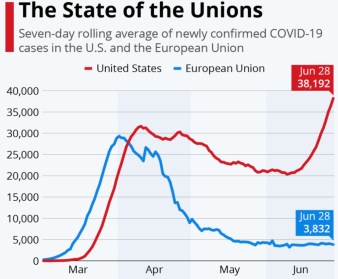

If one picture captures this change more starkly and simply than any other, it is this chart from The Johns Hopkins University.  Covid.jpegMillions of Americans have already seen this chart on television and in newspapers, and millions more will see its iterations in the days ahead.  The two lines, or “curves,” it displays compare the seven-day rolling averages of COVID-19 cases in the United States with those in the European Union.  These “curves” were nearly identical as the pandemic got underway.  It didn’t take long, however, for them to diverge, and diverge sharply.

Most European nations moved quickly to contain the virus, locking down their societies, banning public gatherings, and forbidding their citizens to move about freely, thereby limiting their ability to infect others.  As draconian as these measures were, they produced the hoped-for result.   Cases and fatalities began to decline steeply.  Even the hardest-hit EU countries, like Italy and Spain, are now able to reopen their societies and begin rebuilding their economies with a reasonable measure of safety.

The opposite is true in the United States.  Although a handful of northeastern states successfully beat back the first outbreak, largely by emulating strict European measures, dozens of largely Republican-led states—egged on by Donald Trump—declared that they had had enough and abruptly opened the floodgates.  The consequences have been predictable and tragic, and all the more tragic for being utterly avoidable.  From South Carolina to South Dakota, pandemic-denying politicians and populations now find themselves engulfed by a viral wildfire.  As infections and deaths mount by the day, the United States has become the epicenter of the global pandemic, with no end in sight.

The two “curves” on Johns Hopkins chart illuminate more than differing responses to a biological catastrophe.  They reveal fundamentally different social, political, and economic systems, one of which is succeeding while the other is not.

It is the European system that is succeeding, and it is succeeding for three reasons:

The first and most elemental is that the social democracies of Europe treat healthcare as a necessary public good, to which all citizens are entitled.  The national healthcare systems of Europe, though pushed to the edge by the pandemic, were better able than ours to meet the threat.  What’s more, when the bills come due for COVID-19 care, there won’t be many Europeans declaring bankruptcy because they can’t afford to pay.

The second reason is that the nations of the European Union have refused to bow to the iron dictates of “the market”.  To sustain their economies, they have, first and foremost, supported their citizens.  There is no talk, as we hear endlessly from Republicans in the United States, of such support being a “disincentive to work”.  As a result, the rate of unemployment in the EU is less than half what it is in the United States, businesses are in far less distress, and economic activity will almost certainly rebound more quickly.

The final and most important reason is cultural.  There is a sense of social solidarity and shared responsibility in Europe that is utterly absent in the United States.  No country exemplifies this contrast more clearly than Italy, where social and familial bonds are the stuff of life itself.   Yet, when the pandemic struck Italy and struck hard, Italians from Padua to Palermo, from Milan to Messina, responded to the calls of their government to lock themselves away, for the sake of protecting their friends, their families, and their fellow Italians.  For the famously gregarious Italians to have willingly accepted months of virtual solitary confinement speaks volumes about the differences between European and American societies.

These differences were expressed with brutal clarity in recent remarks by the Governor of South Dakota, a Republican politician named Kristi Noem: 

I believe in our freedoms and liberties.  What I’ve seen across the country is so many people give up their liberties for just a little bit of security, and they don’t have to do that.  

Since Ms. Noem’s principal qualification for public office was a stint as South Dakota’s “Snow Queen,” it is hardly surprising that she has not even the foggiest idea of the true meaning of liberty.  No person is entitled to exercise untrammeled freedom to the detriment of others; no other person is required to risk his or her life to indulge the fantasies of reckless libertines.  That isn’t liberty, it is criminal negligence.  Not a single serious thinker on the subject, from John Locke to John Stuart Mill, has ever suggested otherwise.  

Unfortunately, the Governor of South Dakota is no naive anomaly.   Millions of Americans hold similar views.  That is because American society is, at bottom, fundamentally selfish.  Our veneration of market capitalism is a thinly disguised form of personal greed.  Our version of “liberty” is a license for irresponsible individuals to do whatever they wish, regardless of the consequences for everyone else.  Our shrill assertions of personal freedom are the equivalent of childish, one might even say infantile, tantrums.   That is why an infantile idiot now occupies the White House.  That is why the United States of America is now the epicenter of the global pandemic.

Don’t get me wrong.  In drawing this contrast between Europe and the United States, it is not my purpose to suggest that Europe is a Utopia.  On the contrary, it is beset by numerous flaws and failings, conflicts and contradictions. Its long history has been marred by bloody wars and incomprehensible carnage.  Despite all that—perhaps because of all that—the social democracies of Europe have constructed a sense of the public good that we have lost or never had.  Two days ago, there were 188 COVID-19 cases in all of Italy.  In the state of Florida alone, there were more than 15,000.  Two cultures, two curves.  You decide which choice you want to make.

The Pathology of the Police

Tiberius GracchusAs millions of Americans took to the streets to protest the brutal murder of George Floyd and countless other black Americans at the hands of police officers, who have for decades felt entitled to ignore the laws they are sworn to enforce, some called for “defunding” police departments altogether.  This sparked a predictable outcry on the political right and no less predictable fears on the left that such a suggestion might provoke a backlash, one that could play straight into the hands of Donald Trump.  Indeed, Trump is already casting himself as a cultural caped crusader, denouncing lawful demonstrators as terrorists.  Whether the risk of such a backlash is real, I am in no position to judge.  Worrying about it, however, poses the very real risk of distracting us from more fundamental questions.   
Do the police actually do what they are supposed to do, which is to keep us safe?  What are we really getting in return for the $200 billion dollars we spend every year on policing and prisons, border security and border walls?  No less importantly, what do we truly know about the qualifications, skills, and character of the people to whom we give so much power? 

Whatever else you may think of American law enforcement, there is little doubt that our country is, by any objective measure, grotesquely over-policed.  We have 18,000 local police departments, almost 100 federal law enforcement agencies, more than a million full-time law enforcement officers, and another 400,000 prison guards.  None of this includes a never-counted myriad of part-timers, private subcontractors, and “citizen cops,” many of whom are lawless vigilantes in all but name.  

The most pernicious consequence of this vast apparatus of policing and suppression is that we incarcerate more of our citizens, by far, than any other country in the world.  With less than five percent of the world’s population, we have 25 percent of its prisoners.  By that standard, the “Land of Liberty” is little better than a Gulag state.    

As to the question of what we get in return for the billions we spend, the answer seems to be:  not much.  There is no credible evidence that it has any effect on criminal activity.  Crimes rates in the United States have been declining steadily for more than 20 years.  They were dropping all the while police budgets were being cut; they continued to drop when spending began to rise.  Crime is declining in red states and blue states, and in communities all across the country, without regard for the size or resources of police departments.  Crime, it would seem, has a mind of its own, which pays scant attention to the cops.

What’s more, for all the money we spend on policing, most crimes are never solved, let alone prevented.  A mere 18 percent of the seven million cases of non-violent crimes committed each year are ever “closed”.  Of the million or so violent crimes, fewer than half lead to any sort of resolution.  Even fewer are prevented—because most violent crimes are acts of domestic assault, which happen out of sight, behind closed doors.  When the police finally arrive, if they ever do, it’s already too late.  

In any event, it is by no means clear that police officers are equipped to handle such situations in the first place.  Only 30 percent of police officers are college graduates, as opposed to 34 percent of the general population and 100 percent of public school teachers.  They lack the training or skills to function as social workers, marriage counselors, or psychologists, and yet, they are paid as if they were. The average police officer makes $68,000 a year.  That’s $16,000 more than the average American and $10,000 more than the average public school teacher.  Cops, in short, are under-qualified for the work we expect them to do and overpaid for the work they are actually capable of doing.

This contradiction is usually rationalized by the claim that police officers “put their lives on the line every day” and deserve to be compensated accordingly.  That fairy tale is a fiction in the service of a fraud.  Not only is police work not especially hazardous, it is remarkably safe.   

In 2018, the most recent year for which reliable statistics are available, a grand total of 55 police officers—out of a population of more than a million—died in “felonious” encounters with criminals.   Those deaths were lamentable in every sense, but they do not paint a picture of a uniquely dangerous profession.  Roughly the same number of Americans die each year from lightning strikes, and the number of deaths in the logging, commercial fishing, or roofing businesses makes police work seem like the safest of sinecures.

At the same time, police officers kill more than 1,000 Americans every year.  That’s the “official” number at least.  Since few police departments keep proper records and many deliberately misclassify the fatalities perpetrated by their officers, the real number is double or even triple the official tally. 

Which brings us to the most important question of all:  what do we really know about the psychological fitness of the people to whom we give so much power and deference?  The answer is:  almost nothing.  

Hard as it is to believe, the last serious study of police psychology was conducted in 1917.  It is even harder to believe that researchers exhausted the subject a century ago and thereafter lost all interest.  It is more likely that police departments stonewalled further research, just as they routinely conceal the misbehavior of their officers.  What they can’t conceal, however, is the pathological combination of aggression and aggrieved victimhood that too many of them display and all too often flaunt. 

If you want to understand this pathology, begin by asking yourself why anyone would go into police work in the first place.  

Some no doubt see it as a true calling, a chance to “serve and protect” their communities.  Human nature being what it is, the number of those who feel this noble tug is bound to be small.  Others don the uniform for purely practical reasons, given the fact that a high school kid with few skills and generally bleak prospects would be hard pressed to find a better job.  Being a cop is neither intellectually nor physically demanding, it pays well, and it provides health and retirement benefits that are beyond the reach of most Americans.  

And then there are those who go into policing for more ominous reasons.  Lured by the trappings of authority, they relish the chance to strut and swagger, to throw their weight around and intimidate those who wouldn’t bother to give them the time of day if they weren’t wearing a badge.  Such people are drawn to power and brute force as antidotes to their own insecurities.  They are, at bottom, bullies.  It is no coincidence that the major police unions are enthusiastic supporters of Donald Trump.  Bullies in blue are all too eager to embrace a bully in chief.

In a sprawling and conflicted country like ours, which is difficult to govern on the best of days, policing may be a necessary evil.  But we must never forget that it is an evil, nonetheless.  The police are the armed enforcers we employ to keep our worst instincts in check.  They are not selfless heroes worthy of being lionized.   On the contrary, they frequently overstep their bounds and turn their power against the very people they are sworn to protect.  Accordingly, we should treat the police warily, with suspicion and constant scrutiny.  We should limit their numbers to the bare minimum required to “protect and serve”.  When they break the law, we should hold them to the same standards that apply to everyone else.  And when they cling to the pathologies of racism, aggression, and brutality, we should root them out and, yes, defund them.

The Normality of Evil

Tiberius GracchusFrom the day Donald Trump “won” the presidential election nearly four years ago, we have been admonished against normalizing either the man or his governing agenda.  To do so, we are told, would run the risk of numbing us to Trump’s boundless misdeeds, pave the way for him to exercise his authoritarian instincts, and blind us to the “better angels” of the American character.  Trump, it has been said time and again, is a monstrous exception to those better angels, does not represent the national character, and should be rejected for the anomaly that he supposedly is.

Foremost among those who have recited this refrain is the former President of the United States, Barack Obama.  During a recent “virtual commencement address” to the graduating class of 2020, delivered remotely because of COVID-19, he said the following:

It’s not always pretty, this democracy of ours—trust me, I know. It can be loud and messy and sometimes depressing. But because citizens took seriously the mandate that this is a government of and by and for the people, bit by bit, generation by generation, we’ve made progress—from cleaning up our air and water, to creating programs that lifted millions of seniors out of poverty, to winning the right to vote and to marry who you love.  None of these changes happened overnight, or without sustained effort. But they did happen, usually because young people marched, and organized, and voted, and formed alliances, and just led good lives, and looked out for their families and their communities and their neighborhoods and slowly changed hearts and minds.

Barack Obama’s intentions are beyond question as good as they can be, since he is a thoroughly decent man.  The sentiments expressed in this case, however, are anodyne and naive.  Not only that, they paint such a selective picture of our history that they border on falsehood or fantasy. 

Far from being an aberration, Donald Trump is the very epitome of a true American type.  From P. T. Barnum to Bernie Madoff, from Billy Sunday to Billy Graham, our history is rife with con men and charlatans, who grew rich by deluding the greedy and the gullible, often with the eager connivance of those they deceived.   That is because greed and gullibility have been intrinsic to the American character from the very beginning.  For all that we idolize the freedom-seeking Pilgrims who landed at Plymouth Rock, many of the earliest immigrants to these shores were debt-ridden grifters, who came here to avoid prison or the hangman’s noose.  Like most of their ilk, they also came here to get rich quick, and they didn’t much care how they went about it.  The nation we like to call “the greatest in the world” is the product of four centuries of theft, slavery, and genocide.

Moreover, the proposition that our history has been a steady forward march of social and economic progress is manifestly absurd.  For each of the forward steps Barack Obama mentioned in his virtual commencement address, there have been steps back; for all the tremendous gains, there have been terrible losses.

A mere 12 years after the Civil War came to an end, in the course of which 600,000 lives were sacrificed to end the obscenity of slavery, the seditious southern states that started the war were allowed to impose “Jim Crow,” a de facto form of slavery that succeeded in oppressing black Americans for another hundred years.  The Civil Rights Act of 1964 was supposed to end that oppression—until the right-wing majority that now dominates the Supreme Court gutted its most important provisions.  Within days of that decision, the unrepentant states of the old Confederacy rushed to suppress voting rights again, redrawing their electoral maps to further entrench white supremacy.

In 1954, a very different Supreme Court barred racial segregation in public schools in the landmark case, Brown v. Board of Education.  And yet, 75 years later, most public schools remain segregated, in fact, if not in law.  An implicit system of prejudice—in which banks deny mortgages to people of color, realtors steer their customers to the “right” neighborhoods, and local schools are funded by a tax regime that favors affluent (a.k.a., “white”) residents—has all but neutered the court’s decision.  There is no longer any need for out-and-out white racists like George Wallace to bar the doors of public education to people of color.  The subtleties of the “free market” have done the job far more effectively.

Four decades after the Supreme Court affirmed, for the first time in our history, the right of women to make their own reproductive decisions, right-wing conservatives on the court are hell-bent on overturning that decision.  It is not yet clear whether they will abolish Roe v. Wade outright—Chief Justice John Roberts is not conspicuously courageous—or will settle for a more politically expedient slow death by a thousand cuts.   What is clear is that, one way or another, they are determined to have their way.

In sum, the “better angels” narrative perpetuated by well-intentioned people like Barack Obama is an inexcusable distraction from the ugly reality that Donald Trump’s monstrosity isn’t at all abnormal or exceptional.  On the contrary, it is all too normal, all too typical, all too characteristic of who we are and who we have been.  

Just as the United States military was once called upon to suppress or exterminate the Sioux, the Cheyenne, the Arapaho, and the Pawnee, it is now being called upon to suppress the voices of protest on American streets.  Just as local police once used billy clubs to bully black Americans into submission, they are now using bullets to silence them altogether.  

To pretend that these are the acts of “a few bad apples” and that the rest of us are free of complicity or blame is a colossal lie.  As long as we refuse to confront the deep-seated wrongs that shaped our history and still poison our society, we all, each and every one of us, will be guilty of normalizing evil.

No Going Back

Tiberius GracchusAs his poll numbers bob up and down like a yo-yo and his reelection prospects grow more rickety by the day, Donald Trump is rolling the dice, wagering not only his own political fortunes but the lives of thousands of Americans on the off chance that, by reopening the country, the economy can somehow “get back to normal”.  This, all the while COVID-19 infections and deaths continue to mount, particularly in the states and rural communities that constitute “Trump country”.  

Putting aside the corrupt self-interest of both Trump himself and his Republican enablers, the yearning to return to some approximation of “normality” is widely felt and entirely understandable.  But it is also a delusion.  Whatever “normal” was before the global pandemic swept us up in its lethal embrace, the “normal” we are returning to is going to be something altogether different.

The philosopher George Santayana famously observed:  “Those who cannot remember the past are condemned to repeat it.”  That mordant comment is more relevant today than ever, and it applies to Americans, in particular.  Our country’s failure to prepare for this pandemic, as well as the reality that lies ahead, is a specifically American failure of imagination and humility in the face of history’s complete disregard for the self-congratulatory conceits of countries and civilizations.  For more than 200 years, we have flattered ourselves for being an “exceptional nation,” as if the United States were somehow capable of avoiding the iron grip of history.  Thanks to COVID-19, we are exceptional no longer.  History has caught up with us, and it is confounding our conceit.

We are not the first to confront the disorienting reality that a way of life once assumed to be enduring can evaporate in an instant.  Consider the thousand-year-long period we call the Middle Ages.  That remarkable epoch reached its glorious apogee in the 13th century, when hundreds of magnificent cathedrals thrust their vaulted naves and lofty spires heavenward; when knowledge and learning were reborn, as renowned universities were founded in Oxford and Cambridge, Paris and Padua; when philosophical and theological thought reached a pinnacle in the works of William of Ockham and Thomas Aquinas; when Giotto began to paint, and Dante began began to write.  And yet, a mere 10 years after Giotto laid down his brush, the medieval world was suddenly torn loose from its moorings.  

On an early October day in 1347, a small flotilla of Genoese merchant ships drifted into the harbor of Messina in Sicily, carrying the riches of the east in their cargo holds.  They were also carrying rats, and those rats were infested with fleas carrying bubonic plague.  By the time the ships tied up at the docks, most of their sailors had already suffered a horrible death.  All that was left were putrescent corpses oozing puss.  

Within months, the Black Death, as it came to be called, spread throughout Europe, and by the time its first wave subsided, at least a third of the population had been wiped out.  For the next 300 years, other waves spread over the continent, drowning Europe in a roiling rip tide of disease and death.

This unprecedented catastrophe not only cost millions of lives, it utterly transformed what remained of economic, social, and political life.  Institutions and norms, supposedly ordained by god and once accepted without question, were cast aside.

So few peasants were left to work the fields that serfdom collapsed, and the poorest of the poor were able, for the first time in centuries, to challenge their betters.  Massive peasant revolts broke out.  Most were eventually suppressed, but the ruling classes, who once imagined themselves to be untouchable, had been taught the lesson that their grip on power would never again be absolute or secure.

Vast swaths of property were abandoned, as owners and occupants succumbed to the scourge.  The laws governing property rights and inheritance, carefully codified and ruthlessly enforced, simply collapsed.  The result was one of the greatest transfers of wealth in history and the upending of the medieval social order.  It wasn’t long before the sharp-eyed, deep-pocketed merchants of the bourgeoisie refused any longer to bend their knees to kings and aristocrats.

Belief in the eternal verities of the Catholic religion began to crumble, as no amount of ritual and prayer proved capable of fending off the plague bacillus.  When it became painfully obvious that the faithful died no less often than the faithless, men turned away from the authority of the Church and looked to themselves, hoping to make sense of a world that no longer operated by the rules they had been taught.  Such “heretical” thinking spawned the Protestant Reformation.

COVID-19 is not the Black Death (at least not yet), nor is it likely to completely upend the global order.  Its transformative power is nonetheless far from negligible and is already making itself felt.  

During the Democratic presidential primaries, “mainstream” candidates like Joe Biden lambasted progressives for daring to suggest that private, for-profit health insurance should be replaced by a single-payer system.  Why, they asked, should Americans be deprived of the employer-provided health insurance they supposedly “loved”?  Now, we know the answer.   Millions of those people are suddenly out of work and have no health insurance at all.  Who is going to pay their medical bills?  Our private, for-profit health care system has been exposed for the sham, and scam, that it is—a system that is utterly incapable of caring for the nation in crisis without massive government intervention.

Before the pandemic struck, Donald Trump blustered endlessly about creating “the greatest economy in history”.   That claim was always a con, and thanks to COVID-19, the con has become painfully obvious.  Even as the Trump’s financial finagling pumped up the stock market, the real economy was gasping for breath.  Credit card and student loan debt reached new highs; real wages, adjusted for inflation, were little changed from what they had been a generation earlier; the average household didn’t have enough cash to pay for a $400 emergency.  The wealthy few were indeed wealthier than ever, but the rest were living on the edge.  

The pandemic has pushed millions of Americans over that edge.  Nearly 40 million have lost their jobs.  Many can’t pay their rent or utility bills.   In the months ahead, hundreds of thousand will be forced to declare bankruptcy.  In their desperation, thousands more are already queuing up to get food handed out by charities.  Hand-outs may tide people over, but their desperation and dependence will breed nothing but humiliation, leaving wounds that never heal and scars that can never be erased.

Worse than any of that, COVID-19 has revealed, once and for all, the callous cruelty of American capitalism.  The disgraced but unrepentant former Fox News host, Bill O’Reilly,  dismissed the cost of reopening the economy as trivial, because the victims of the pandemic “are on their last legs anyway”.  The Republican chief justice of Wisconsin’s supreme court belittled a major outbreak in a local meat packing plant, because it didn’t affect “regular folks”.  The governors of Iowa and South Dakota, Republicans both, warned workers that, if they refuse to return to their jobs because they are afraid of becoming infected, they will be denied unemployment insurance.  The Republican governor of Nebraska, a multi-millionaire and major Trump donor, defended meat processing companies in his state that refused to disclose the infections in their plants, because “that’s a business decision”.   The message is clear.  Profit matters more than people.  The Dow matters more than the death toll. 

As I write, the number of American lives claimed by the pandemic is approaching 100,000.  By the time you read this, the toll will almost certainly have passed that grim milestone.  It may be that many Americans will respond to this calamity by embracing the false promises of the pathological liar who occupies the White House.  Or, it may be that, after decades of false promises, they will turn in a different, more hopeful direction.  

I have no idea which choice my fellow citizens will make or what the future holds.  But I do know this.  The new normal won’t be the normal we left behind.  This pandemic has exposed the fundamental failings of our society.  We can confront those failings and try to change them, or we can try to excuse them away.  But we can no longer pretend that they do not exist.  There is no going back.  

Open for Business, No Matter the Cost

Tiberius GracchusTen days ago, Donald Trump unveiled his so-called plan for declaring the United States “open for business” after several weeks of what amounted to a national lock-down.  To pretend that his grandiose proclamation was a “plan” in any meaningful sense would be grotesque.  What Trump and his minions gave us was little more than a bullet list of “guidelines,” which lacked the force of law and were bereft of any concrete commitments on the part of the federal government.  To states and municipalities across the country, Trump declared, in effect:  “You’re on your own.  Have a nice day.”

And as it turned out, it didn’t take long for Trump himself to scuttle the very guidelines he had just proposed.  Within hours, the Great Pumpkin scurried back to Twitter—his rhetorical drug of choice—to gin up the grievances of his equally drugged-up followers, exhorting them to “liberate” themselves from the oppressive tyranny of having to stay at home in order to avoid killing themselves, their families, or their neighbors.  If Donald Trump were an ordinary citizen, rather than the coddled cuckoo who, owed to our crazy electoral system, is safely closeted in the Oval Office, he would long ago have been dragged away in handcuffs for reckless endangerment.  

None of this should surprise us, for it is merely the culmination of an orchestrated right-wing effort to downplay the danger of COVID-19.  From the pretentious pontificators who write for the National Review, to the bloviating editorial pages of the Wall Street Journal, to the Trump sycophants who huff and puff for a living at Fox News, conservatives have for weeks been trying to undo every effort to fight the most lethal global pandemic in a hundred years.

Their first line of attack was to dismiss this virus as an “hysterical” hoax, likening it to “the common flu”.  As the number of infections and deaths mounted, this claim collapsed under the weight of its own implausible mendacity. 

Their next trick was to assail the statistical models used by health experts to estimate the likely consequences of the pandemic, with the aim of undermining the credibility of the experts themselves.  When the model of choice inside the White House lowered its initial estimates of the likely death toll, the aforementioned National Review bellowed:  “To describe as stunning the collapse of a key model the government has used to alarm the nation about the catastrophic threat of the coronavirus would not do this development justice.”  The statistical ignoramuses at the National Review were caught completely flat-footed, when, just a few days later, the model they had singled out for opprobrium turned out to be, not overly “alarming,” but excessively cheery.  As the death toll kept rising, that model was revised again, but this time, upward.  Faced with such inconveniently unpleasant news, the National Review and other pandemic-deniers immediately went silent.   

They next turned to bemoaning the economic consequences of trying to mitigate the virus.  Trump declared: “We need to make sure the cure isn’t worse than the disease.”  Ron Johnson, a rich but particularly stupid Republican Senator from Wisconsin, took up the refrain:   “I am concerned that the cure is worse than the disease.  If you’re a carpenter, every nail you see, the solution’s a hammer.  The same may be true for epidemiologists.”   In the midst of a global pandemic, only tone-deaf plutocrats like Johnson (or Trump) would think it might be useful to compare the handiwork of carpenters with the scientific expertise of epidemiologists.   

As stupid as such comments were, it didn’t take long for other Republicans to go much further.  A Congressman from Indiana named Trey Hollingsworth declared:

It’s time for policymakers to put on their big-girl and big-boy pants and decide between the lesser of two evils.  Do we try to save more lives or our livelihood?  Restart the economy and kill more people or keep staying home and kill more jobs?  The answer is unequivocally to get Americans back to work, to get Americans back to their businesses.

In these words, the moral philosophy of the Republican Party was distilled to its toxic essence. Forced to choose between killing jobs and killing people, Representative Hollingsworth was quite prepared to kill people.   

Needless to say, this did not go down well with millions of ordinary Americans who don’t wear “big-girl and big-boy pants” and are less than enthused by the prospect of sacrificing themselves on the altar of GDP.

So, the pandemic-deniers moved on to their last and most desperate gambit:  denouncing efforts designed to mitigate the virus as a violation of of “civil liberties”.  Libertarian loons like Senator Rand Paul of Kentucky likened shelter-in-place orders to “house arrest”. Our borderline-crazy Attorney General, William Barr, hinted that the Justice Department would side with anyone who sued the states to overturn those orders.  And Donald Trump, the pandemic-denier-in-chief, urged his followers to take to the streets to “save our Second Amendment,” as if social distancing somehow threatened gun rights and blue-state governors were tyrants like George III.

In a dozen state capitals across the land, Trump’s dim-witted fans dutifully complied, brandishing Confederate flags and automatic weapons.  One of these gullible nincompoops blurted to a reporter:  “I don’t want the government telling me what to do.  If I wanna go out, that’s my right.  I’ll take responsibility.  The same for other people. “  This is tantamount to saying:  “I don’t want the government telling me I can’t drive drunk.  If kill myself or somebody else, that’s nobody’s business but my own.”  It scarcely needs saying that such moral idiots would be the first to howl if the government left them to bleed to death after wrapping their cars around a tree. 

All of this begs a fundamental question:  Why are conservatives so hell-bent on pushing the country to “open for business,” even when that almost certainly means that millions more will get sick and thousands more will die?  

One Republican congressman provided an answer to that question, with more candor than he probably intended:

If this goes on much longer, the government is gonna have to get more and more involved.  We’ll lose our freedom.  We’ll lose the free market.   Capitalism could collapse.

Our country has become the epicenter of this global pandemic, precisely because it is the epicenter of global capitalism—a system that elevates private gain over the public good.  Such a system cannot possibly solve the greatest public crisis since the Great Depression.  Conservatives know this, and they are right to be afraid, because the global pandemic has exposed the cruel contradictions of the economic and social system they idolize.  As every day passes, as the death toll mounts, as the gap between the privileged few and the disposable many becomes more painfully obvious, more and more people will ask themselves whether such a system is worth the cost.

When Worlds Collide

Tiberius GracchusIn the closing decades of the 2nd century AD, a plague swept over the once invincible Roman Empire.  Brought back by returning legions after a military campaign in the east, the pestilence spread swiftly and in all directions.  As luck would have it, the greatest physician of the ancient world, Galen, was practicing medicine at the time.  Thanks to his meticulous descriptions of the symptoms and trajectory of the disease, historians have concluded that the “Aurelian Plague”—named after the reigning emperor and Stoic philosopher, Marcus Aurelius—was probably smallpox.  

The “Aurelian plague” was the first pandemic in history, infecting every province of the Roman Empire, from the Tigris to the Thames, from the Rhine to the Rif, and killing as much as 25 percent of its population.  This devastation ignited a political, economic, and social crisis that lasted almost a hundred years.

And yet, the Roman Empire not only survived this crisis, it went on to recover much of its former glory.  Scarcely more than 50 years after the last vestiges of the plague disappeared, the emperor Constantine built a new capital on the shores of the Bosporus, which soon surpassed Rome itself in both population and magnificence.

What accounted for this remarkable turnaround?

The answer is that the forces which produced the pandemic also led to the recovery.  The Roman Empire was the closest the world has ever come to a “global” political and economic system, in which public and private interests were unified and subordinated to a single purpose.  It wasn’t “global” in a modern sense, of course.  Large parts of the world were either unknown to the Romans or beyond their reach or ambitions.  Even so, their empire spanned three continents, controlled the entire Mediterranean, and extended its sway to the remote British Isles.  Nothing like it had existed before or has existed since.

One of this empire’s greatest achievements was the creation of transnational market, knit together by fifty thousand miles of peerless roads and secure shipping lanes that stretched from the Red Sea to the Straits of Gibraltar.  This astonishing economic network that so efficiently moved spices and gems, silks and incense, wines and wheat, also spread the plague bacillus.  The first global market became the conduit for the first global pandemic.

The globalism of the Roman Empire had another dimension, however, which proved vital to its recovery.  In addition to a unified system of transportation and commerce, the Romans gave much of the world a single government and civilization, whose citizens were bound together by a shared sense of duties and obligations.  There was no confusion about who was in charge.  There was no doubt about what was at stake.  

That is not the situation we face today.  We live in two contradictory and opposing worlds, one economic, the other political.  Those worlds are now colliding.  

On the one hand, we inhabit the world of global capitalism.  For decades, we have luxuriated in the consumer goods and services provided by this system while paying scant attention to its perils.  One of those perils is now consuming us.  While global capitalism did not create COVID-19, the market mechanisms it has spawned have spread the disease, exacerbated its severity, and undermined our ability to respond. 

The global tourism business, for example, enticed half a billion Americans, Europeans, Latin Americans, East Asians, and Chinese to travel abroad last year.  As long as these hordes of people were merely carrying overstuffed luggage and duty-free baubles, nobody gave it much thought.  Now, we know that many of them were also carrying disease and death.

More fundamentally, the dynamic of global capitalism, which is the pursuit of profit, has only made things worse.  The drive to push down costs by pushing the means of production to far-flung countries where labor is cheap has created attenuated and fragile supply chains, “just-in-time” production, and razor-thin inventories of even the most essential goods.  Hospitals throughout the world are now scrambling to find ventilators and protective equipment, because global capitalism has no incentive to produce a single face mask, a single pair of gloves, or so much as an ounce of hand sanitizer, unless those goods can be sold for an immediate profit.

Nowhere is the failure of this system more painfully apparent than in the United States, where, as I write, the number of coronavirus cases has pushed past half a million and bulldozers in New York are digging trenches to bury the dead.  America’s private, for-profit health care system has proved to be so woefully unprepared to cope with the pandemic that several American states have for all intents and purposes “socialized” their own healthcare systems.

Even as the global economic system has helped to spread and exacerbate the pandemic, no parallel global political system exists to combat it.  Instead, the political world we inhabit is comprised of competing and increasingly selfish nation-states.  The United Nations is merely a consultative, not a governing, body.  The World Health Organization can advise and admonish, but it cannot prescribe or compel.  The International Monetary Fund and the World Bank are charged, not with supporting the global economy, but with protecting creditors and punishing debtors.  No governing institution, in short, has the authority or power to mount a defense against a truly global threat, let alone lead the world to recovery.

The United States once again exemplifies the problem at its worst.  Just as the world lacks institutions capable of dealing with a global crisis, the United States lacks its own institutions capable of dealing with a nationwide crisis.  Our antiquated “federal” system, in which states are free to make their own decisions about universal human needs and rights, has always been absurd.  Now, it is turning tragic.  

There is some comfort in the fact that a few states—like Washington, California, and New York—have led the way in combatting the pandemic.  This shouldn’t blind us, however, to somber reality that other states—mainly in the South, all run by Republicans—are stubbornly clinging to the ideology of the market and putting the lives of their citizens at risk.  That our country has far and away the largest number of COVID-19 cases in the world and will soon have the highest death count, is no accident.  When the “Aurelian Plague” swept through the Roman Empire, the citizens of that empire could at least console themselves that an enlightened and diligent ruler sat on the throne.  The Romans had Marcus Aurelius.  We have Donald Trump.

One would like to think that, when this pandemic is behind us, people will wake up to the fact that a runaway global economic system requires global governance, or at least a global governing consensus, capable of containing its excesses and combatting its perils.  If that realization fails to dawn, the two opposing worlds we live in will soon collide again, bringing another pandemic or even more catastrophic climate change.  Next time, there may be no coming back.

Life Is Sacred—Until It’s Not

Tiberius GracchusFrom the day, 40 years ago, when Ronald Reagan was elected president, evangelical Christians, in both their Protestant and Catholic incarnations, have steadily tightened their grip on our political life.  That is because Reagan popularized and legitimated their radical ideas, and they, in turn, embraced and enlisted him in their counter-revolutionary crusade against the liberal mores of the modern world.
Ronald Reagan was an improbable apostle to spread the gospel of the evangelical counter-revolution.  He rarely attended church.  He divorced his first wife to marry another, violating the strictures of the Presbyterian denomination to which he nominally belonged.  He displayed no evident personal interest in spiritual or theological matters.  And his public expressions of religious sentiment were, on the best of days, scarcely more than empty platitudes.  There is, in sum, no evidence that Ronald Reagan was especially pious or devout.  

He was, however, nothing if not a shrewd politician and, as such, he was keenly aware of the political potential of appealing to, and exploiting, religious feeling.  More to the point, the political b-movie in which he played a starring role—America’s quasi-religious crusade against “godless communism”—required a supporting role for the Christian god.  For without that god in the script, there could have been no godless villain; and without that villain, there would have been no need for the heroic protagonist Reagan had cast himself to be.  

Even as he played his part in this political psycho-drama, it is not at all clear that dear old “Ronnie” understood how the tale was going to end or how far it might go.  On the contrary, if he were still with us today, it is entirely possible that he might actually be horrified by the complete capitulation of the Republican Party to its evangelical wing.  

Nothing epitomizes that capitulation more starkly than the so-called “pro-life movement,” which was birthed in 1973 in reaction to the Supreme Court’s decision in Roe v. Wade.  That ruling established, for the first time in our history, that women have the right to make their own reproductive decisions.   The “pro-life movement” was formed to overturn that decision, to abolish and criminalize abortion under all circumstances, and, for good measure, to quash any possibility of ending the suffering of those who are terminally ill or cognitively dead.  The capitulation of the Republican Party to this cause is now so complete that any candidate who dares to disagree with the “pro-life” agenda knows that his or her political life will quickly suffer its own premature death.

The foundational argument of this movement is that “life is sacred” and inviolable—always and absolutely, without exception or reservation.  From the start, this argument has been riddled with moral inconsistencies, logical contradictions, and rank hypocrisy.  

To begin with, many “pro-lifers” are entirely comfortable with the notion of condemning their fellow human beings to the electric chair, gas chamber, or hangman’s noose, not to mention contaminating the planet or exterminating millions of God’s other creatures.   Moreover, few “pro-lifers” pay much attention to the question of what actually constitutes a meaningful human life.  For most of them, it would seem to suffice that a sperm bumps into an egg, a droplet of condensation clings to the tube of a respirator, or a vestigial electrical charge continues to register long after life has been extinguished.  Most of us, I suspect, have a more expansive notion of what it means to be a human being. 

Then there is the uncomfortable question of what really motivates the “pro-life” movement.  For all their talk about the sanctity of life, it has long been clear that those who oppose abortion are as determined to suppress the sexual and reproductive choices of women as they are to save the “unborn”.  They insist that pregnant women bear children they do not want and cannot afford to rear, yet they won’t raise a finger to help them.  They oppose contraception on the grounds that any attempt to prevent pregnancy is morally impermissible, even though contraception would, by definition, prevent the “crime” they say they abhor.  They insist that legal “personhood” begins at the moment of conception, which is absurd on its face.  And they do all this in the name of “traditional family values,” which is a scarcely concealed euphemism for a social structure that has, for centuries, allowed men to dominate and control the lives of women.  

This blatant hypocrisy may have begun with Ronald Reagan, but it didn’t end with him, and now, in the midst of the global coronavirus pandemic, its fraudulence has become inescapably obvious.  

Just days ago, the Republican Lieutenant-Governor of Texas argued that older Americans should be prepared to sacrifice themselves to save the “American way of life” for their children and grandchildren, by which he meant an economy that allows those children and grandchildren to go on spending and consuming until there is nothing left to consume.  Right-wing economists immediately chimed in, as did the anchors and paid talking-heads on Fox News.  Donald Trump, ever attentive to his own self-interest, proclaimed that “the cure can’t be worse than the problem,” insisting for a time and against all medical and scientific advice, that the country should “re-open for business” as soon as possible, an act that would lead to the deaths of hundreds of thousands of Americans.

Let’s be crystal clear.  What “pro-life” Republicans are saying, what Trump has been asserting, what his evangelical supporters are affirming, is that human life is not, in fact, “sacred” or inviolable—always and absolutely, without exception or reservation.  Confronted with the prospect of losing money, they have changed their tune.  Now, they are openly asserting that human life is negotiable, that human life is a mere commodity, fit to be weighed on a scale that balances benefits against costs.  

I do not know how or when this pandemic will end.  I do not know how many lives will be lost.  But I do know this.  Those who demand the sacrifice of human lives for the sake of the Dow Jones Industrial Average cannot credibly insist that the “sacred life” of an embryo must be preserved no matter what it costs a woman.  

The foundational argument of the “pro-life” movement—that life is sacred and inviolable under any and all circumstances—has crumbled under the weight of its own moral contradictions and hypocrisy.  Nothing can put this Humpty-Dumpty back together again.  

It Takes a Crisis

Tiberius GracchusVirtually everyone is familiar with this famous quip by Winston Churchill:

No one pretends that democracy is perfect or all-wise.  Indeed, it has been said that democracy is the worst form of government except for all those other forms that have been tried from time to time.

Most of us focus on the final phrase, which praises democracy, and pay scant attention to the more critical assessment that precedes it.  In reality, both parts of Churchill’s aperçu are correct.  Democracy may be superior to other forms of government, but it is neither perfect nor all-wise.  On the contrary, it is particularly clumsy and cumbersome.  

Routinely riven by differing opinions and interests, hobbled by the tedious process of political accommodation and compromise, democratic governments are seldom able to address the most fundamental problems or effect systemic social and economic changes, even when majorities of their populations support such changes.  Nevertheless, powerful elites throughout history—monarchs and aristocrats, intellectuals and plutocrats, even our own “founding fathers”—have been fearful of the supposedly “radical” tendencies of democracy, failing to realize that democratic governments are in reality inherently conservative.  I don’t mean “conservative” in the ideological sense but, rather, in the practical sense.  However radical democratic rhetoric may sometimes be—”man the barricades,” “off with their heads,” “power to the people,” and the rest—democratic governments in practice are slow to move, loath to take risks, and reluctant to tinker with long-standing customs and habits.

Until there is a crisis.

When an unexpected crisis arises—be it a war, an economic collapse, a plague, or a natural calamity—democracies can suddenly turn on a dime, leaving both their advocates and critics equally breathless.   Obstacles that once seemed insuperable are swept away.  Tasks that once seemed impossible are tackled in a minute.  Social and economic goals that once seemed forever out of reach are quickly embraced and enacted.  When otherwise cumbersome democracies eventually stir themselves, they can move with all the force and speed of stampeding cattle.  

The direction this stampede takes, however, is not preordained, and it can just as easily lead to a productive or destructive destination.  The course any particular democracy follows in responding to a crisis depends upon the strength of its institutions, the caliber of its leaders, and—above all else—the moral character of its citizens.  These are lofty standards, and history is rife with examples of democracies that have failed to reach them.

More than 2,000 years ago, the democracy of ancient Athens was ravaged by a devastating plague in the midst of a long and debilitating war with its arch-foe, Sparta.  The citizens of democratic Athens allowed themselves to be cajoled by a charismatic demagogue named Alcibiades and to embark upon a risky military expedition against the fabulously rich Sicilian city of Syracuse.  The result was a bloody debacle.  Athens lost the war, its empire went up in smoke, and Athenian democracy—the first in the world—never recovered.

After a hopeful and enlightened beginning, another democratic government, put in place by the French Revolution, found itself assailed on all sides by the forces of reaction.  Its response to that crisis was the infamous “Reign of Terror,” in which Louis XVI and his queen Marie Antoinette, several thousand “aristos,” and many more conservative members of the peasantry and petit-bourgeoisie were summarily executed.  In the chaos that ensued, Napoleon Bonaparte seized control, abandoned and betrayed the first republic in French history, and declared himself emperor—all to popular, “democratic” acclaim.  We all know how that turned out.

Benito Mussolini came to power “democratically” in the wake of Italy’s humiliating defeat in the First World War, only to discard democracy and install himself as the dictator of a fascist state.  We will never know how many Italians actually embraced fascism or merely made their peace, as Italians have done for centuries, with what they deemed to be the prevailing political wind.   What we do know is that Italian democracy was, for a time at least, seduced by its own Alcibiades.

The same can be said, with consequences far more grave, of Hitler’s Germany.  It was not only military defeat in 1918 but the economic collapse of 1929 that enabled Hitler to come to power, a crisis in which the Deutschmark became worthless, personal savings were wiped out, and the economy of Germany descended into chaos.  Although Hitler’s ascent was not itself democratically achieved, there is little doubt that the vast majority of the German people enthusiastically supported the murderous regime he imposed upon the country to solve its economic and political woes.  In that sense at least, Hitler was a truly “democratic” figure.

These are chilling examples of democracies spurred by crises to act in terrible and destructive ways.  But such reactions are not inevitable.   Sometimes, an existential political, economic, or natural crisis is the only force sufficiently powerful to move a democracy forward.

That was certainly the case in 1932, when Franklin Delano Roosevelt was elected president in a landslide of historic proportions, and Americans finally decided that they had had enough of the false promises and empty bromides of  Herbert Hoover and the Republican Party.  All the while millions were losing their jobs and any ability to sustain themselves or their families, Hoover had condemned government action as a “dole” that would weaken the country by undermining “the work ethic,” as if there were any work to be had.   The only advice his sinfully rich Secretary of the Treasury, Andrew Mellon, was prepared to offer a desperate nation was:  “Liquidate labor, liquidate stocks, liquidate the farmers, liquidate real estate.  Purge the rottenness out of the system.”

In the face of such amoral nonsense and confronting the crisis of the Great Depression, American democracy changed course swiftly and dramatically.  The frothy exuberance of the “Roaring Twenties” gave way to the “New Deal,” which in turn gave the nation the Social Security system, federal deposit insurance, the electrification of large, previously ignored swaths of the country, price stability for American farmers in place of a feast-or-famine economic regime, unprecedented investments in public infrastructure, and a thousand other innovations and advancements that we now take for granted.

The crisis we now confront is no less dire than the crisis that began in 1929.  It might even turn out to be worse, because it threatens, not only our economic survival, but our very lives.  The days ahead are going to be long and dark.  None of us knows—I certainly don’t—when or how all this will end.  

I do know, however, that we have fundamental choices to make and the opportunity to make choices that we never before thought possible.  As each day goes by, this crisis is tearing the scabs off the unhealed wounds of our society:  our pitifully inadequate health care system, the pitiless sink-or-swim ethic of our economic system, the grotesque inequalities that allow the rich, the socially privileged, and the politically powerful to further empower themselves at the expense of everyone else.  

This crisis gives us a chance, perhaps a last chance, to change all that.  We can choose well or badly.  That is now entirely up to us.