Two Cultures, Two Choices, Two “Curves”
by Gracchus
 The old adage that “a picture is worth a thousand words” has never been more apt than it is today, as we face the twin crises of the worst global pandemic in a century and an economic contraction more serious than anything since the Great Depression. The immediate consequences of these parallel calamities are serious enough, but their potential long-term effects are positively epochal. All the while most of us are focused on getting through today and surviving tomorrow, the fundamental assumptions that have guided our public life for the better part of fifty years are crumbling.
If one picture captures this change more starkly and simply than any other, it is this chart from The Johns Hopkins University. 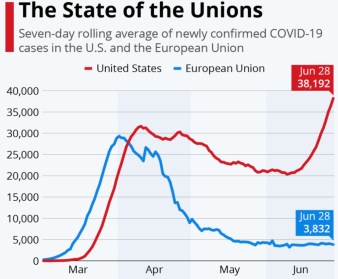 Millions of Americans have already seen this chart on television and in newspapers, and millions more will see its iterations in the days ahead. The two lines, or “curves,” it displays compare the seven-day rolling averages of COVID-19 cases in the United States with those in the European Union. These “curves” were nearly identical as the pandemic got underway. It didn’t take long, however, for them to diverge, and diverge sharply.
Most European nations moved quickly to contain the virus, locking down their societies, banning public gatherings, and forbidding their citizens to move about freely, thereby limiting their ability to infect others. As draconian as these measures were, they produced the hoped-for result. Cases and fatalities began to decline steeply. Even the hardest-hit EU countries, like Italy and Spain, are now able to reopen their societies and begin rebuilding their economies with a reasonable measure of safety.
The opposite is true in the United States. Although a handful of northeastern states successfully beat back the first outbreak, largely by emulating strict European measures, dozens of largely Republican-led states—egged on by Donald Trump—declared that they had had enough and abruptly opened the floodgates. The consequences have been predictable and tragic, and all the more tragic for being utterly avoidable. From South Carolina to South Dakota, pandemic-denying politicians and populations now find themselves engulfed by a viral wildfire. As infections and deaths mount by the day, the United States has become the epicenter of the global pandemic, with no end in sight.
The two “curves” on Johns Hopkins chart illuminate more than differing responses to a biological catastrophe. They reveal fundamentally different social, political, and economic systems, one of which is succeeding while the other is not.
It is the European system that is succeeding, and it is succeeding for three reasons:
The first and most elemental is that the social democracies of Europe treat healthcare as a necessary public good, to which all citizens are entitled. The national healthcare systems of Europe, though pushed to the edge by the pandemic, were better able than ours to meet the threat. What’s more, when the bills come due for COVID-19 care, there won’t be many Europeans declaring bankruptcy because they can’t afford to pay.
The second reason is that the nations of the European Union have refused to bow to the iron dictates of “the market”. To sustain their economies, they have, first and foremost, supported their citizens. There is no talk, as we hear endlessly from Republicans in the United States, of such support being a “disincentive to work”. As a result, the rate of unemployment in the EU is less than half what it is in the United States, businesses are in far less distress, and economic activity will almost certainly rebound more quickly.
The final and most important reason is cultural. There is a sense of social solidarity and shared responsibility in Europe that is utterly absent in the United States. No country exemplifies this contrast more clearly than Italy, where social and familial bonds are the stuff of life itself. Yet, when the pandemic struck Italy and struck hard, Italians from Padua to Palermo, from Milan to Messina, responded to the calls of their government to lock themselves away, for the sake of protecting their friends, their families, and their fellow Italians. For the famously gregarious Italians to have willingly accepted months of virtual solitary confinement speaks volumes about the differences between European and American societies.
These differences were expressed with brutal clarity in recent remarks by the Governor of South Dakota, a Republican politician named Kristi Noem:
I believe in our freedoms and liberties. What I’ve seen across the country is so many people give up their liberties for just a little bit of security, and they don’t have to do that.
Since Ms. Noem’s principal qualification for public office was a stint as South Dakota’s “Snow Queen,” it is hardly surprising that she has not even the foggiest idea of the true meaning of liberty. No person is entitled to exercise untrammeled freedom to the detriment of others; no other person is required to risk his or her life to indulge the fantasies of reckless libertines. That isn’t liberty, it is criminal negligence. Not a single serious thinker on the subject, from John Locke to John Stuart Mill, has ever suggested otherwise.
Unfortunately, the Governor of South Dakota is no naive anomaly. Millions of Americans hold similar views. That is because American society is, at bottom, fundamentally selfish. Our veneration of market capitalism is a thinly disguised form of personal greed. Our version of “liberty” is a license for irresponsible individuals to do whatever they wish, regardless of the consequences for everyone else. Our shrill assertions of personal freedom are the equivalent of childish, one might even say infantile, tantrums. That is why an infantile idiot now occupies the White House. That is why the United States of America is now the epicenter of the global pandemic.
Don’t get me wrong. In drawing this contrast between Europe and the United States, it is not my purpose to suggest that Europe is a Utopia. On the contrary, it is beset by numerous flaws and failings, conflicts and contradictions. Its long history has been marred by bloody wars and incomprehensible carnage. Despite all that—perhaps because of all that—the social democracies of Europe have constructed a sense of the public good that we have lost or never had. Two days ago, there were 188 COVID-19 cases in all of Italy. In the state of Florida alone, there were more than 15,000. Two cultures, two curves. You decide which choice you want to make.
 gracchusdixit
Yeah, this whole thing is part of the reason I’m considering quitting my job. With folks in Texas still vacillating between open the schools or don’t open the schools, I’m not gonna be eager to be at my tutoring center with kids from all these different schools that have opened their doors, should they choose the in-person option.
Also, the constant stress has just driven me batty. People gripe too much about the precautions around here and I’m sure they’re doing the minimum to keep safe. That’s not gonna help.